Damp patches near a chimney breast in Warrington led us to the stack, where the joints, the lead flashing and the crown were all letting rain in. Each was dealt with and the work water tested.
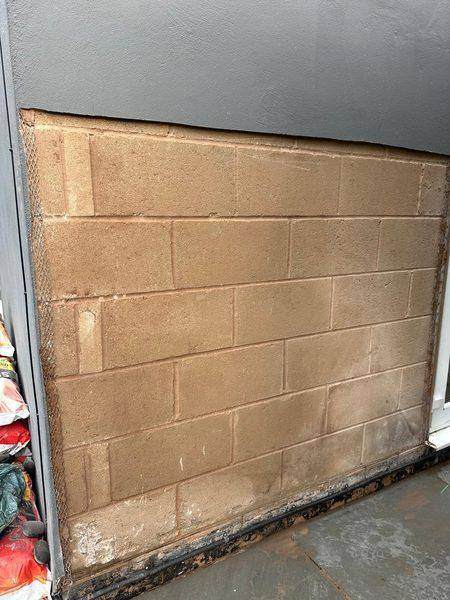
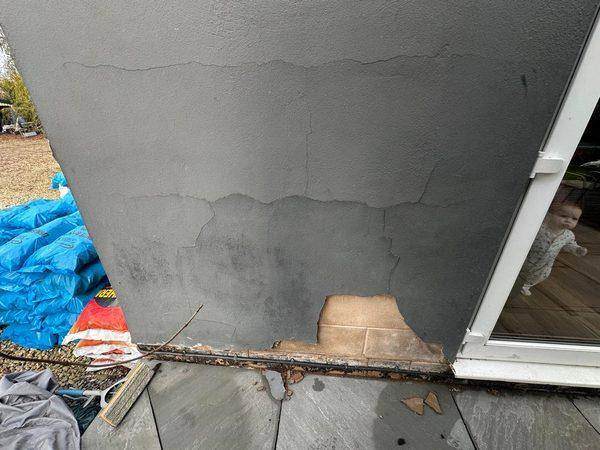
Damp had been showing on the ceiling beside the chimney breast in this Warrington house, and by the time we were called the wall below had started to suffer with it — the render on the painted elevation outside had cracked and blown, and a patch of it had come away from the blockwork altogether. Two of the photographs here are of that wall rather than the roof, because that is where the problem was announcing itself.
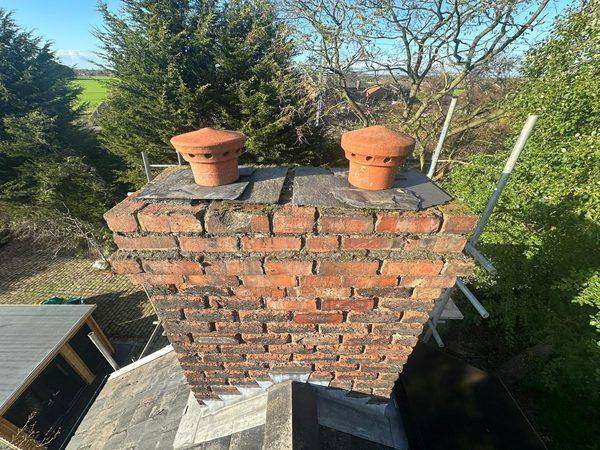
Damp near a breast almost always has its source above, so the stack was the first thing we looked at. It is an old stack on a slate roof, corbelled out at the top, standing over open fields with nothing to shelter it — a stack in that position takes weather from every direction and the mortar goes first. This was straightforward chimney repair work once we could see it properly.
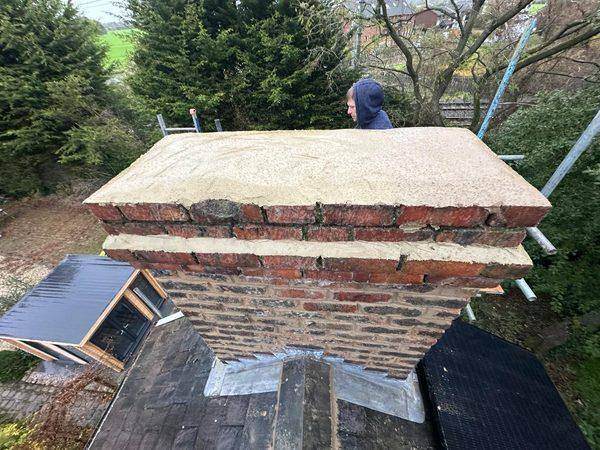
Up on the scaffold there were three separate ways in. The mortar joints through the brickwork were cracked and in places missing entirely, so the courses were open to rain. The lead flashing at the base of the stack had perished and was no longer holding the junction with the roof. And the crown across the top of the stack was damaged, which lets water straight down into the brickwork rather than off it.
You can see the state of the brickwork in the photograph taken in sunshine — weathered faces, eroded joints, the old capping slabs sitting on top with two pots and their cowls above. None of it was going to keep water out on its own.
The damaged mortar was cut out and the stack repointed through, so the joints were closed back up to sound material. The old lead came off and new Code 4 lead went on in its place, chased into the brickwork and sealed, with a flexible waterproof sealant run round the upstand afterwards to finish the line where the lead meets the brick.
The cracks in the crown were repaired and a waterproof coating applied over it, shaped so the top sheds water instead of holding it. While we were there the debris round the flue was cleared out and both pots were checked for stability. A water test at the end showed the route the leak had been taking was closed.
Render that has been wet for a long time does not recover on its own. On this house the blown sections were taken off back to the blockwork so that the wall had a chance to dry out and could be made good on sound material rather than over the top of the damage. The photographs show it both before and after the loose render came away.
If damp is showing near a breast in your house, the stack is the place to start looking. We handle chimney repairs in Warrington from repointing through to new flashing and capping — tell us what you are seeing and we will come and find where it is getting in.
Tell us what the roof is doing and roughly where you are. We will come and look, and you get a written price before anything starts.