A tall Macclesfield stack carrying a bank of clay pots had lost its crown to moss and frost. We took it down, rebuilt it in matching brick, cast a new capping and reset every pot.
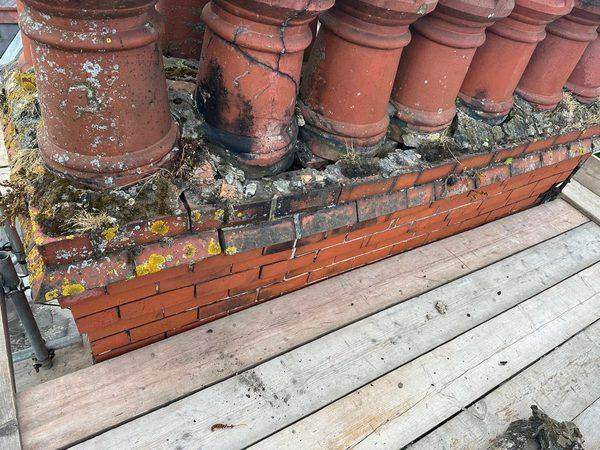
This is a big old stack on a house in Macclesfield, the kind that carries a whole bank of clay pots in two rows because several rooms once had fires in them. By the time we got a scaffold to it the top of the stack had stopped being brickwork and started being something closer to soil. Moss and yellow lichen had taken hold across the crown, small plants were rooted in what was left of the bedding, and the pots were sitting in crumbs rather than mortar.
The brickwork underneath was not much better. The joints in the upper courses had washed out and gone black, one pot had a crack running down it, and the whole top of the stack had softened to the point where repointing alone would have been putting new mortar against nothing solid. What it needed was taking down and rebuilding rather than patching.
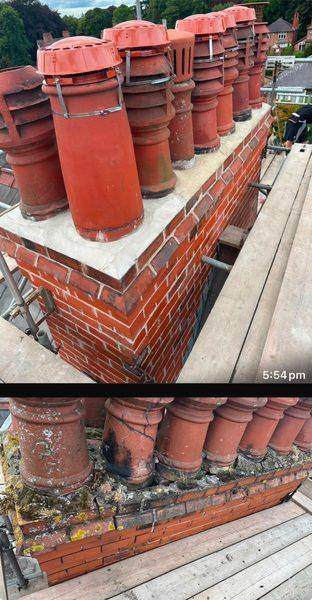
The two before shots are worth looking at closely. In the first, the bedding around the pots has broken up completely — you can see loose lumps of old mortar, green growth packed into the gaps, and a dark sooty stain running down one of the cracked pots. The brick course below it is open at every joint. Water getting into a stack in that condition does not stay at the top; it travels down the flues and the brickwork and comes out as damp on a chimney breast inside the house.
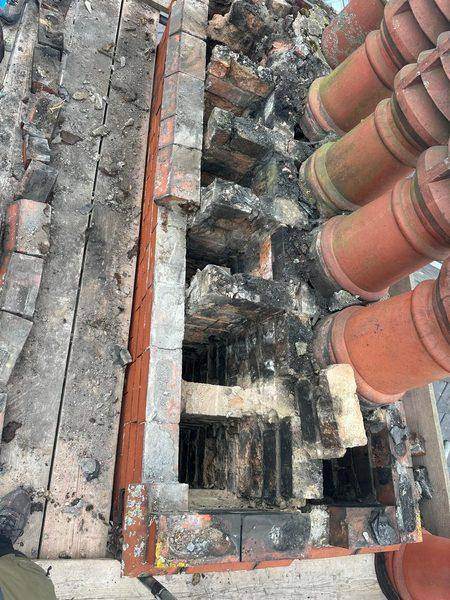
The second photograph is the stack opened up. With the courses off, you are looking straight down into the flues and at the thin brick dividers between them, all of it black with a century of soot. The old bricks came away easily, which tells you how far the frost had got into them.
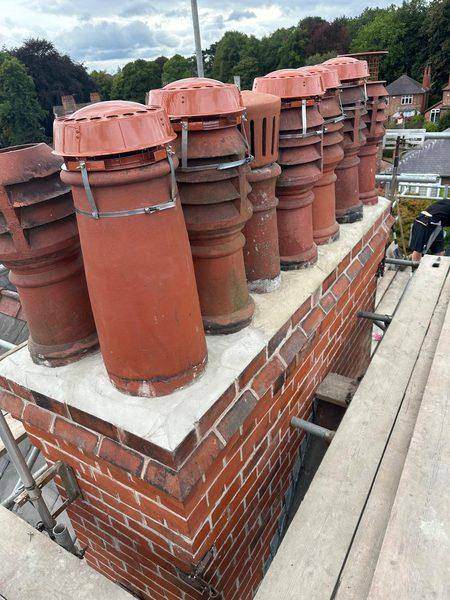
The stack was taken down to sound brickwork and rebuilt in brick chosen to match what was already there, with the joints struck neatly as the courses went up. The flue dividers were carried back up with it so each pot keeps its own flue. On top we formed a new cast capping with a weathered edge that throws rainwater clear of the face of the brickwork instead of letting it run down the stack.
Every pot was then reset into the new capping and finished round its base, and a vented cowl was fitted to each one and held with a strap clamp. The cowls keep rain, leaves and birds out of the flues while still letting them breathe, which matters on flues that are no longer in use as much as on the ones that are.
Not every stack needs this much. Plenty only want the joints raked out and repointed, or the flaunching recast, or new lead where the stack meets the tiles — there is a Macclesfield job with new lead flashing, capping and repointing elsewhere in these projects. The difference is usually whether there is still solid brick to work against, and that is what we go up to look at first.
You can see more of our chimney repairs in Macclesfield, and if there is damp showing on a chimney breast or you can see growth on the crown from the garden, ask us for a free quote.
Tell us what the roof is doing and roughly where you are. We will come and look, and you get a written price before anything starts.