A tired Macclesfield roof with slipped tiles and perished felt, taken back to the timbers, re-felted on a breathable membrane, re-battened and topped with a mortar-free dry ridge kit.
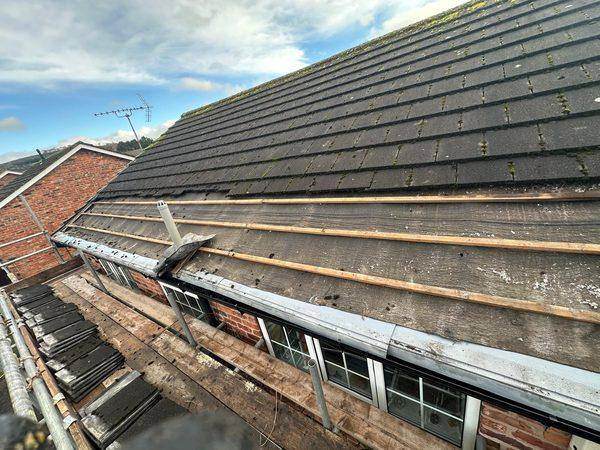
This Macclesfield house had a covering that had simply run out of life. Tiles had crept out of line along the courses, the felt underneath them had gone brittle, and the mortar bedding the ridge was loose and broken up. Patching a roof in that state only moves the problem a course or two along, so the whole area came off.
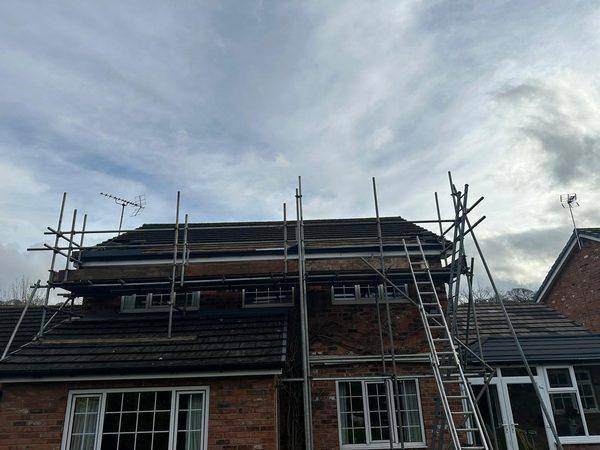
Scaffold went up across the elevation first, with a lift at gutter height and a handrail above the ridge, so the strip could be worked from the top down in safety. Tiles that were still sound were lifted off and stacked on the boards to go back on afterwards; the cracked and broken ones went straight into the skip.
With the tiles away, the old felt and battens came off and the roof was left open to its rafters. Nothing gets covered up until that has been looked over — the batten fixings, the timber itself and the line of the rafters all get a check while they are on show. One photograph here was taken at the eaves with a single course lifted, which is the view that tells you how far the felt has gone: the old sheet had torn along the batten line and was no longer carrying water out to the gutter.
Debris was cleared down as we worked rather than left to build up. The gutter line was kept clear of broken mortar and bits of old felt, which is the sort of rubbish that blocks an outlet weeks after everyone has gone.
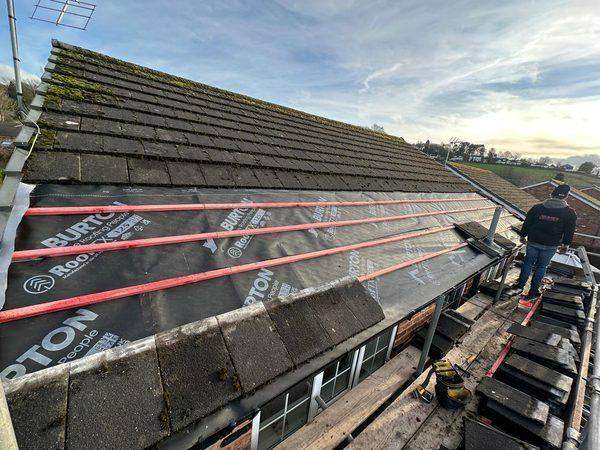
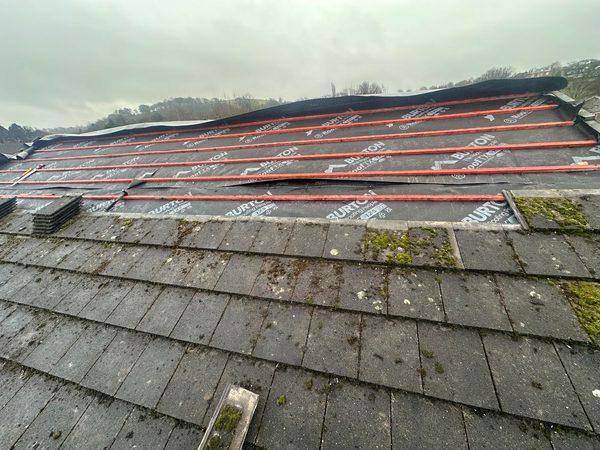
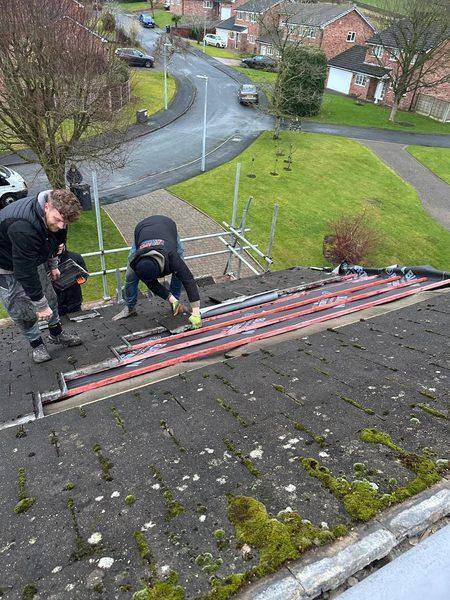
A breathable membrane went on in courses from the eaves upwards, each sheet lapped over the one below so water is always shed onto the outside face. Treated battens were then fixed over the top at the gauge the tile needs, and you can see them in the photographs running as straight red lines up the slope while the old mossy tiles were still sitting on the courses below. Getting that gauge right is what keeps the finished tile courses level and the headlaps honest.
This is the same build-up we use on re-roofing work generally, and it is the part of a roof nobody ever sees once the tiles are back down.
The tiles went back on course by course, and the ridge was finished with a dry ridge kit rather than being bedded in mortar again. A ventilated roll runs the length of the ridge under the tiles, and each ridge tile is held down by its own mechanical fixing. Mortar shrinks, cracks and eventually drops out of a ridge; a clamped ridge has nothing to crack and lets air move out at the top of the roof.
We do the same work across Cheshire — there is more on our Macclesfield roofing page, and a Warrington job where old clay ridge tiles were replaced on a dry fixing system. If your own roof is shedding mortar or losing tiles, send us a message for a free quote.
Tell us what the roof is doing and roughly where you are. We will come and look, and you get a written price before anything starts.