The last mortar-bedded part of a Warrington roof taken off and rebuilt as a ventilated dry ridge, with the half-round tiles refixed mechanically between two panelled slopes.
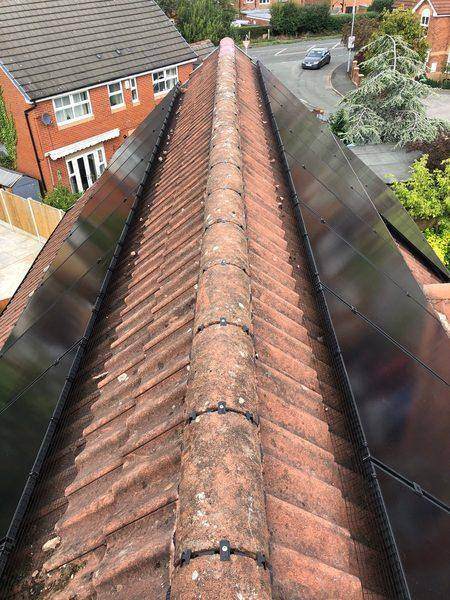
The house is a semi on a Warrington estate, roofed in concrete interlocking tiles that have weathered to a patchy orange and grey and carry lichen along most of the courses. Solar panels cover the greater part of both slopes, with black mesh clipped round their edges to keep birds from getting underneath. The panels stop a course or two short of the apex, which left the ridge line clear to walk and work along.
That ridge was the one part of the roof still held down by mortar. Bedding at the apex never lasts as long as the tiles either side of it: it cracks as the roof warms and cools, the cracks open, and driven rain starts finding a way past the bedding into the roof space. Instead of raking the joints out and bedding the tiles again in fresh cement, we took the whole ridge off and put back a mechanically fixed dry ridge system.
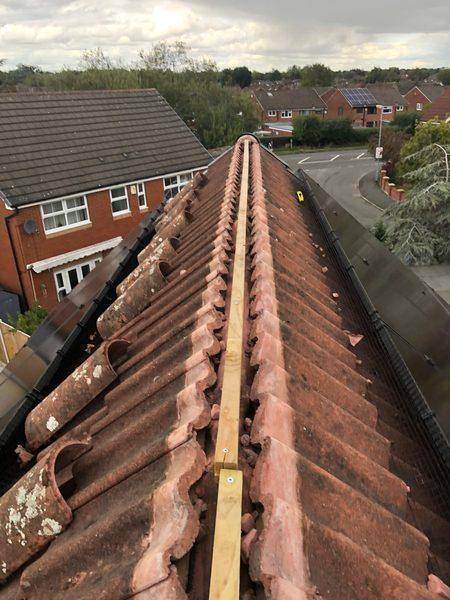
The half-round ridge tiles came off first and were laid out in a row down the slope, which is what you are looking at in the opening photograph. Underneath them the old bedding was broken out and the loose material brushed off the top course on each side, so the apex was clean and we could see exactly what the new fixings were going into. A treated timber batten was then run the full length of the roof and screwed down along the apex to carry the kit.
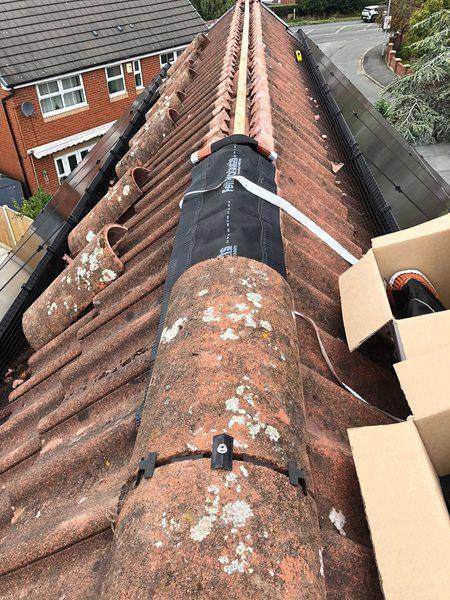
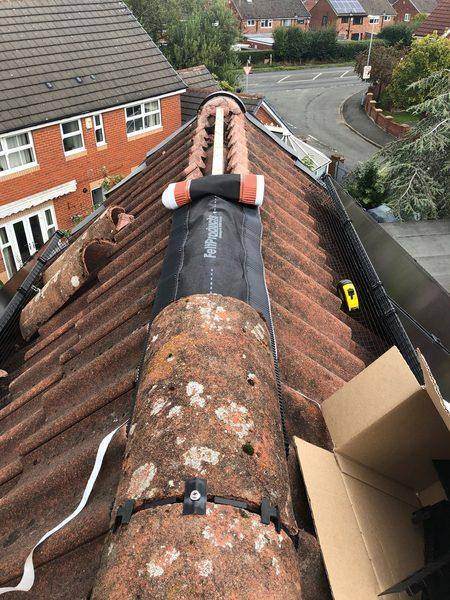
With the batten fixed, the ventilated roll was run out over it straight from the box. There is a butyl strip along each edge of the roll under a white backing tape; the tape comes away as you work down the ridge and the edges are pressed into the tile profile either side, so the join is closed against rain while the apex still breathes. Two of the photographs catch this stage, with the roll half unwound and the kit boxes sitting on the slope behind us.
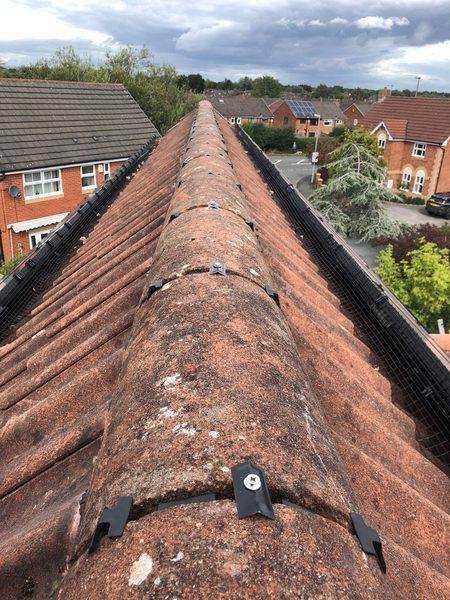
The ridge tiles then went back on over the roll. Each one is held by a clamp that sits in the joint between tiles and is screwed down into the batten underneath, so the line is fixed in place by metal rather than cement. The finished ridge in the last two photographs shows those black clamps evenly spaced along the top of the roof.
A ridge held mechanically moves with the roof instead of fighting it, and there is no bedding left to crack, crumble and drop into the gutters. The ventilation path along the apex also gives warm damp air somewhere to go rather than leaving it sitting against the timbers in the loft. That matters more on a roof like this one, where panels cover most of the slope and nobody wants to be lifting them again in a hurry.
We carry out the same work regularly across the town — there is another dry ridge kit in Warrington among these projects, and more of our dry verge and dry ridge work in Warrington. If your ridge tiles shift when they are touched, or you are sweeping mortar crumbs out of the gutter every autumn, send us a message for a free quote.
Tell us what the roof is doing and roughly where you are. We will come and look, and you get a written price before anything starts.