An older Liverpool roof with a long run of ridge had lost its bedding. We took the clay ridge tiles off, laid a ventilated roll the full length and refixed the tiles mechanically.
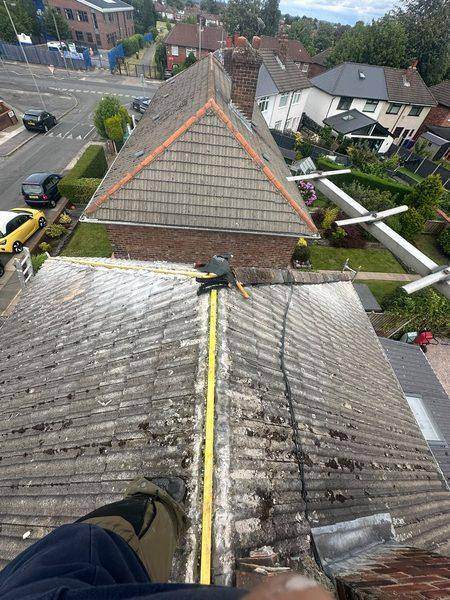
Liverpool's older housing stock throws up a lot of roofs like this one: a deep, steep spread of grey concrete interlocking tiles, streaked pale with lichen, running back a long way from the street with a red brick stack part way along. The ridge is the highest and most exposed line on a roof like that, and on this one it had been sitting on cement bedding for a long time.
Cement at the apex has a habit of going the same way everywhere: it shrinks, it cracks along the joints, and then it starts letting go in pieces. Once that has happened the tiles are held by not very much, and wind and rain get under the edge of them. Our dry verge and dry ridge work deals with exactly that, replacing bedding with fixings that hold mechanically.
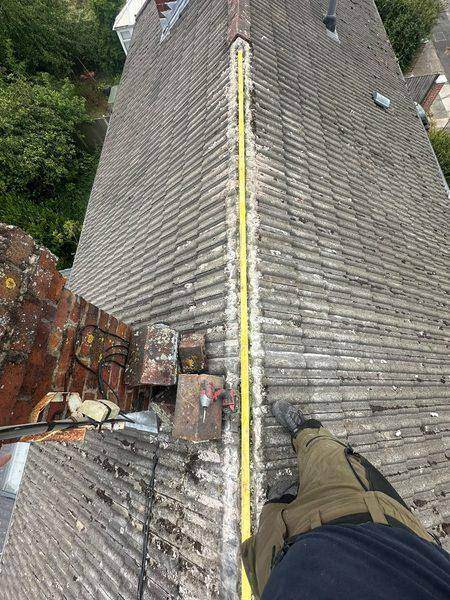
The clay half-round tiles were lifted off one by one and stacked along the slope out of the way, where you can see them sitting next to the tool bag in the second photograph. The old bedding was cleared out of the apex and the tops of the tiles either side brushed down. Then the ventilated roll went out along the ridge, a bright yellow line running the whole way from the stack to the far end, which is what the first two photographs are showing.
That roll does two jobs at once. Its edges bond down onto the tile courses on both slopes to close the gap that used to be filled with mortar, and the middle of it stays open enough for air to move, so the top of the roof space is not sealed shut.
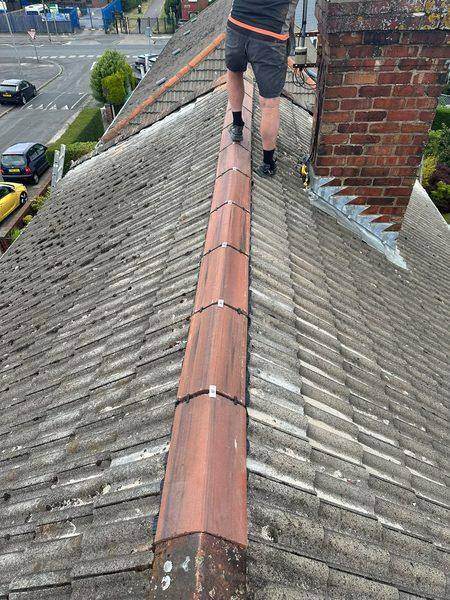
The same clay tiles went back down the ridge, each held by a clip and screwed home rather than floated on cement. In the last photograph you can pick out the pale clips between the tiles all the way along, and the line reads straight from the stack down to the end of the roof. The stepped lead flashing where the brick stack meets the tiles sits right alongside that run, so the top of the roof and the stack junction get looked at together while there is access.
A ridge fixed this way is not relying on a material that hardens and then fails. The tiles are anchored, the joint is sealed by the roll, and the ridge can expand and contract through the seasons without cracking a bed of cement to pieces.
The verge — the edge of the tiling at a gable end — fails in the same way and for the same reason. On the older terraces and semis around the city that edge is very often pointed in cement, and once it cracks the wind gets under the end tiles and birds and insects find their way in behind them. Dry verge units cap that edge instead, clipping over the end tile and screwing down into the batten, with no mortar anywhere in it.
Whether it is the ridge, the verge or both, the aim is the same: take the cement out of the detail and fix the tiles down properly. If the top or the edge of your roof is shedding mortar, drop us a line for a free quote and we will take a look at what is left up there.
Tell us what the roof is doing and roughly where you are. We will come and look, and you get a written price before anything starts.