Where two slopes met on this Warrington roof the old mortar valley had filled with moss and stopped draining. It was taken out and a preformed dry valley fitted, with new underlay and battens either side.
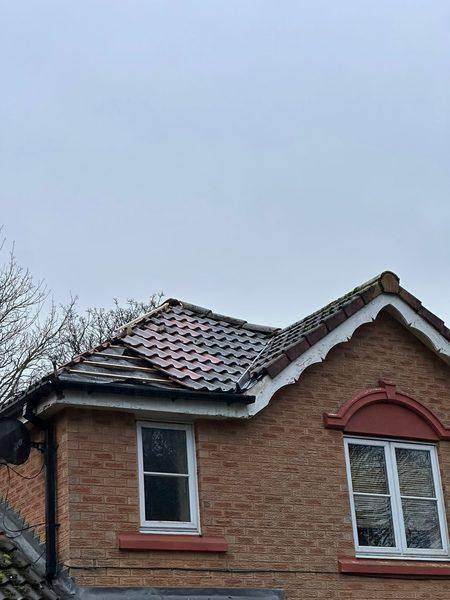
A valley is the internal angle where two roof slopes run into each other, and it is the hardest-worked line on any roof. Everything that lands on both slopes ends up travelling down that one channel, so if it is not draining cleanly the water has nowhere else to go but sideways, under the tiles.
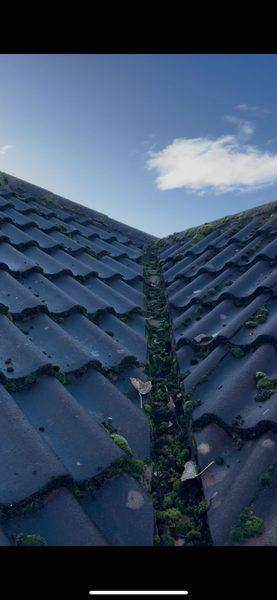
On this Warrington roof the old valley had been formed in cement. One of the photographs shows exactly what that comes to after enough winters: a green strip of moss growing along the full length of the channel, holding damp against the tiles on both sides and slowing the run-off to a trickle.
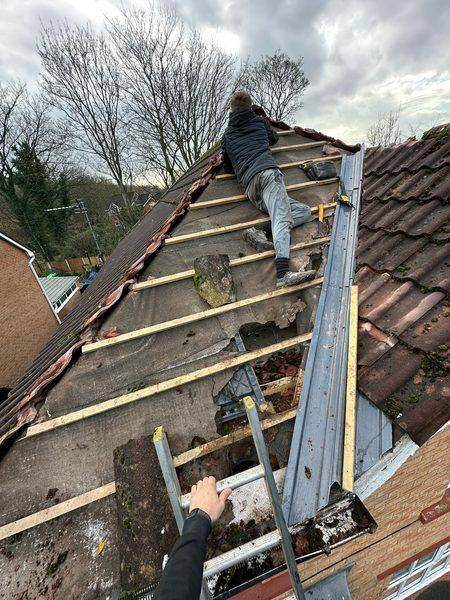
The tiles along both sides of the valley came off first so the channel could be reached from end to end. Old cement was broken out and cleared, and you can see the lumps of it lying loose on the slope in one of the working photographs before it was carried down. Moss and the silt that collects behind it were swept out at the same time.
With the line open, the boards and timbers running down the angle were checked. A valley that has been backing up for years often leaves its mark on the timber below it, and that is worth knowing about before anything new is fixed down.
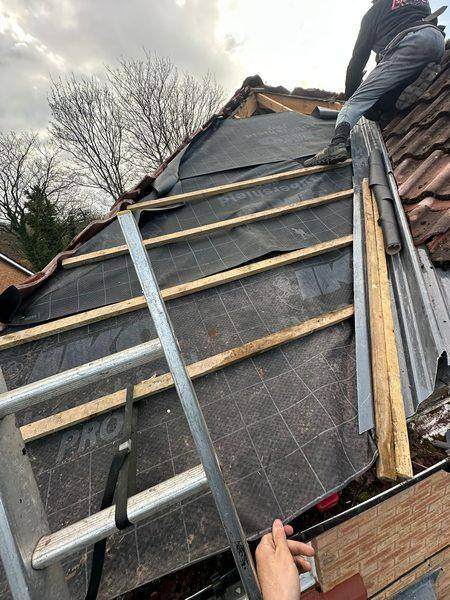
The area either side of the valley was re-covered as the work went back together: fresh underlay run across the slope, then sawn battens fixed over the top, both visible in the photographs with the roll and the lengths of grey sheet still waiting at the edge of the work. Getting the underlay properly into the angle matters as much as the valley itself, because it is the second line of defence if anything ever does get past the channel.
The dry valley is a preformed trough that is set into the angle, lapped along its length so each piece drains into the next, and fixed mechanically rather than stuck down in mortar. Tiles are then cut to run alongside it and close the line neatly. The channel flexes with the roof instead of cracking against it, and there is no rough cement surface for moss to take hold on. Our dry valley, ridge and verge page covers the rest of this work.
Water that cannot get down a valley finds the nearest joint instead, and the damp usually shows up on a ceiling some distance from where it got in. Moss makes it worse in winter by holding water against the tiles until it freezes and lifts them. Both are slow problems, which is why a valley is often the last thing anyone thinks to look at.
If you can see a green stripe running down the angle of your roof, or damp appearing on an upstairs ceiling after heavy rain, it is worth a look. See our Warrington dry verge and valley page, or the felt and batten work we did in Crewe, and ask for a free quote with no obligation.
Tell us what the roof is doing and roughly where you are. We will come and look, and you get a written price before anything starts.