An old flat roof over a brick outbuilding in Warrington was letting water through in heavy rain. The deck had rotted, so it came off in full and we re-boarded and re-covered the whole roof.
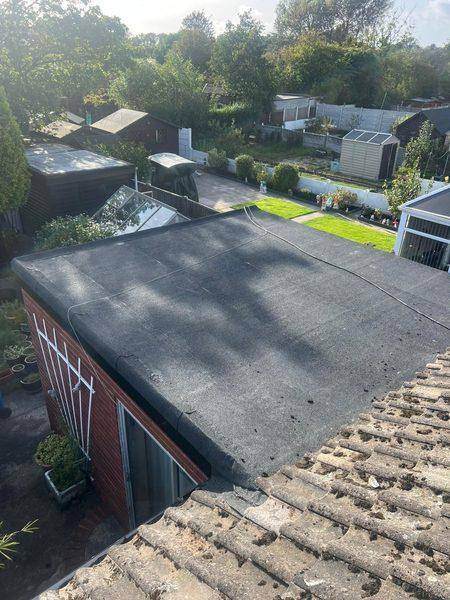
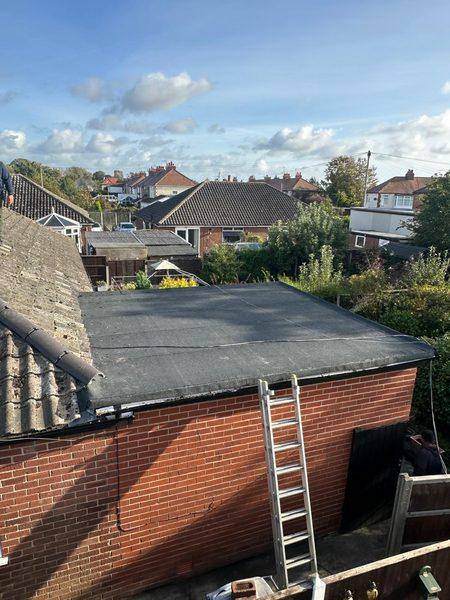
The flat roof over this brick outbuilding in Warrington had been leaking in heavy rain for a while. Flat roofs of a certain age usually fail from the top down: the covering splits or blisters, water gets into the boards underneath, and by the time anyone notices a drip inside, the timber has already been soaking up damp for months. That was the case here.
There was no point patching a covering laid over rotten boards, so the whole roof came off. Taking the deck up also lets us see the joists, which is worth doing before anything new goes down — a covering is only ever as flat and as sound as the boards it is bonded to.
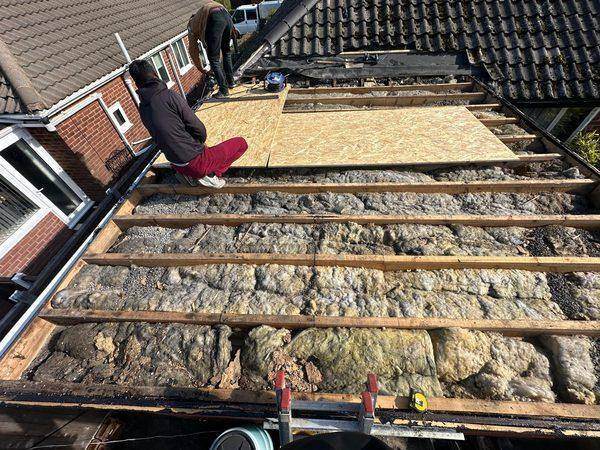
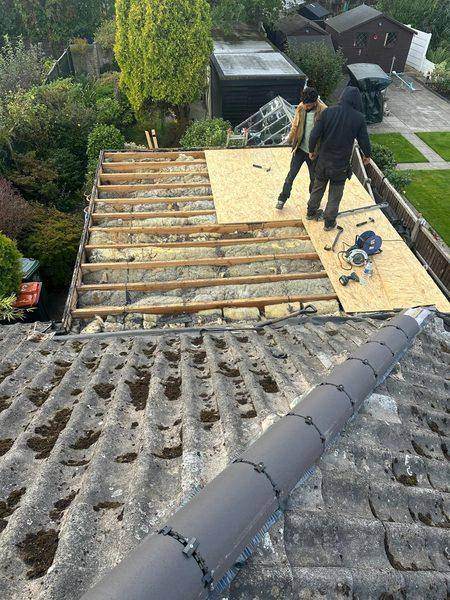
The old covering and the decking under it were stripped out in full. Our second and third photographs show the roof at that stage: bare joists running across the opening with mineral wool packed between them, and the old boards gone. From up on the main roof you can see how long the run is and how little fall it has, which is exactly why the covering had to be right.
With the deck out of the way, the timbers were checked over before anything went back. Anything that has been sitting under a leak needs looking at rather than covering up, because a soft joist will take the new boards down with it in time.
New exterior-grade plywood decking was laid out across the joists, sheet by sheet, and fixed down. You can see the boards going in on the third photograph, with the run of the joists showing the pattern the sheets follow.
The covering is torch-on felt — a bitumen membrane that is rolled out and bonded to the deck with a gas torch, so the material fuses to the boards and to itself rather than relying on adhesive. The laps were sealed as the rolls went on, and new flashing was fitted where the roof meets the brickwork and runs into the pitched roof alongside. The first and last photographs show the finished surface: flat, dark and unbroken, with the seams welted down across the width.
Not every flat roof needs taking off. Where the deck is dry and only the covering has split, a repair is the sensible answer, and we do a good deal of that sort of work — the parapet wall sealing at St Helens is one example. Once the boards have gone soft, though, there is nothing solid left to bond a new covering to, and re-decking is the only honest way forward.
The usual signs are a patch of ceiling that stains again every time it rains hard, a surface that gives underfoot, standing water that never quite clears, or blisters and splits along the laps. You can read more on our flat roof installation page and on the local page for flat roof installation in Warrington. Use the enquiry form for a free quote, with no obligation.
Tell us what the roof is doing and roughly where you are. We will come and look, and you get a written price before anything starts.