Damp marks on a ceiling in Prestbury traced to cracked and slipped Welsh slates. We took the affected slope back to the timbers, laid new felt and treated battens, and relaid it in matching reclaimed slate.
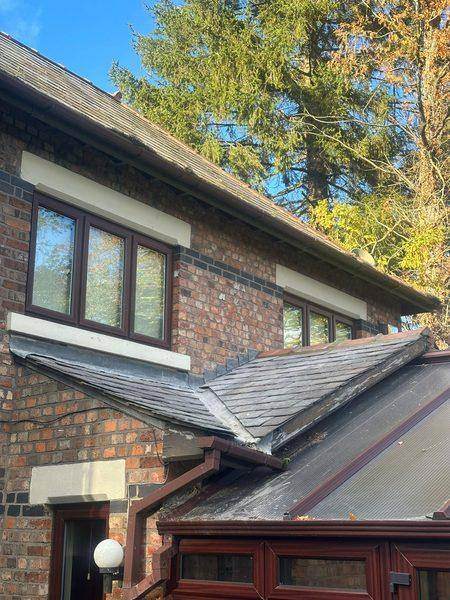
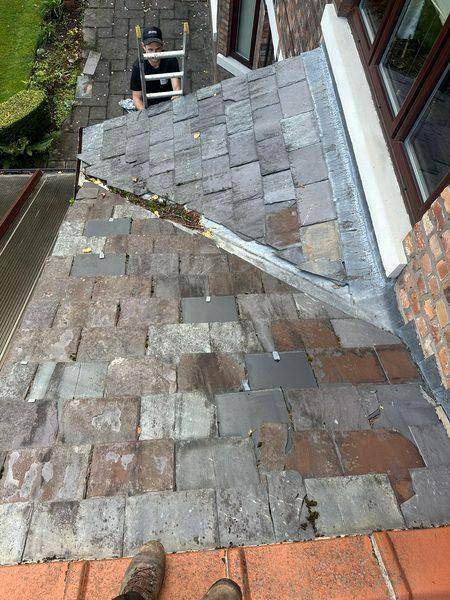
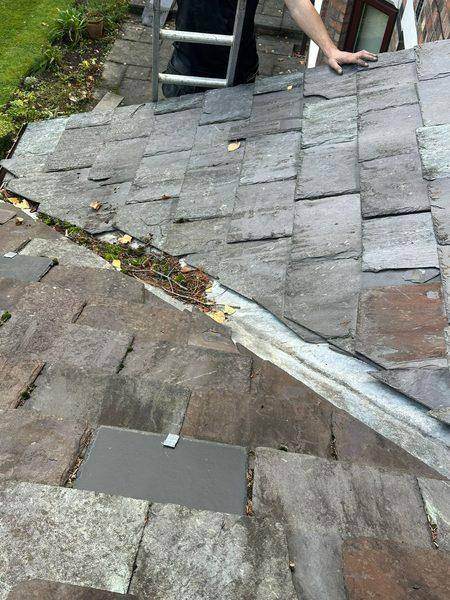
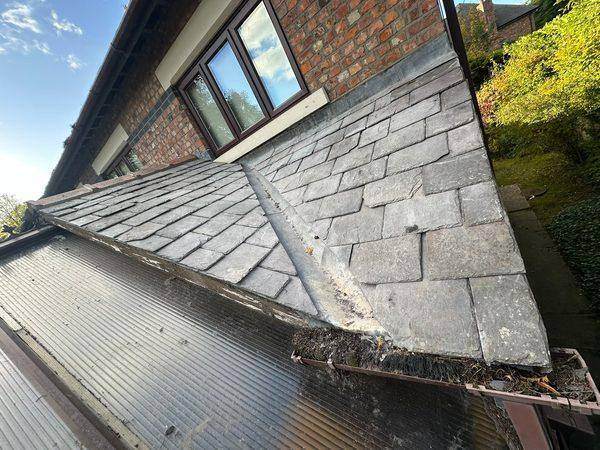
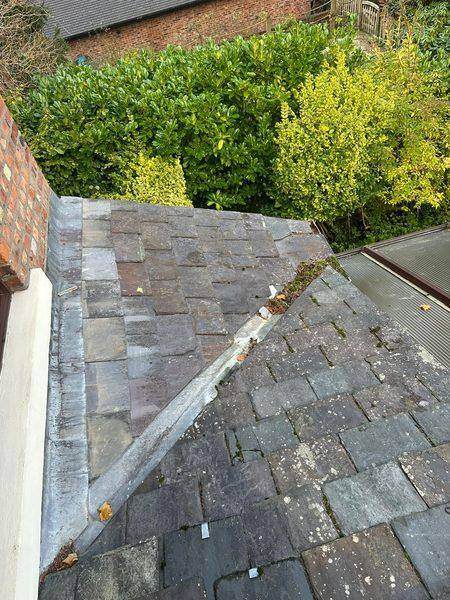
Damp marks had begun to show on a ceiling at this Prestbury house, and the owners wanted the cause found before it spread any further. The covering is Welsh slate, and from the driveway the roof read as tired rather than failing. Up on the slope it was plainer: several slates had cracked across the nail line, a few had slipped out of course altogether, and the underlay behind them had been left holding the weather back on its own.
Slate of that age rarely gives up all at once. Storms lift a corner here and there, the fixings rust, one slate drops, and the slates around it lose their cover. Because the same thing was happening right across the lower range at the side of the house, swapping individual slates would have bought a season at most, so we took the affected area back and rebuilt it from the underlay up.
The original slate is a mix of colours — blue-grey over most of the slope, with rust-brown and dull purple courses where earlier work had gone in. Moss had crept along the joints and into the tail of each slate. Leaf litter off the trees standing over the house had banked up in the lead valley between the two slopes, so rain was sitting against the slate rather than running away down the lead.
The leadwork itself was in reasonable order. We cleared the valley out, looked over the flashing where the lower roof runs into the main wall, and checked the ridge tiles while we were up there, so that nothing obvious was left behind once the slating was done.
The cracked and loose slates came off first, and the perished underlay behind them with it. New breathable felt was laid over the timbers, then new treated battens fixed to the slate gauge so that every course sat with the right lap over the one below.
We relaid the area in matching reclaimed Welsh slate, which is why the finished slope reads as part of the original roof and not as a patch. Where a slate had to go into the middle of a standing course, it was held with a lead tingle — the usual way of securing a slate you cannot nail without lifting everything above it. A larger strip and re-cover of the same kind is shown on our Macclesfield re-batten and re-felt project.
Slipped slates are easy to miss from below, particularly on a lower range half-hidden by a conservatory or a hedge. Damp on a ceiling is often the first thing anyone notices, by which time water has usually been tracking over the underlay for a while. If any of the following sound familiar, it is worth having the slope looked over.
We cover this kind of work across Cheshire from our base in Macclesfield. There is more on what it involves on our roof repairs page, and you can ask for a free quote through the form at the bottom of this page.
Tell us what the roof is doing and roughly where you are. We will come and look, and you get a written price before anything starts.