Age and long-term damp had finished the underlay, battens and lead on this Warrington roof. The affected section was stripped, rebuilt on new underlay and battens, and the lead renewed at the wall.
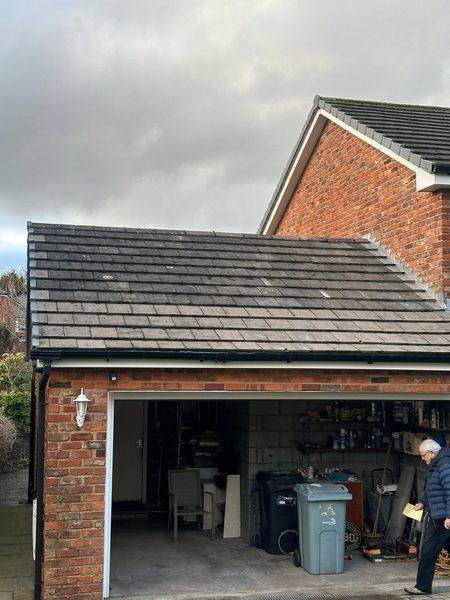
Nothing dramatic had happened to this Warrington roof. It had simply been out in the weather for a long time and the materials under the tiles had reached the end together: the underlay had gone hard and split, the battens had softened where damp had been sitting in them, and the lead at the junctions was no longer holding water out. Tiles on a weak batten will not sit tight, so several had worked loose as well.
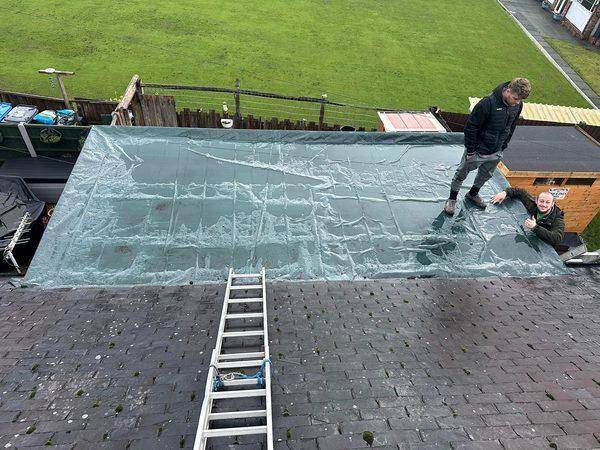
The work was kept to the section that needed it rather than the whole house. Tiles were stripped off, stacked out of the way, and the old underlay and battens came off behind them. Because the roof was open for part of the job, it was sheeted over with a tarpaulin whenever we were off it, which is the photograph with the green cover pulled across the slope.
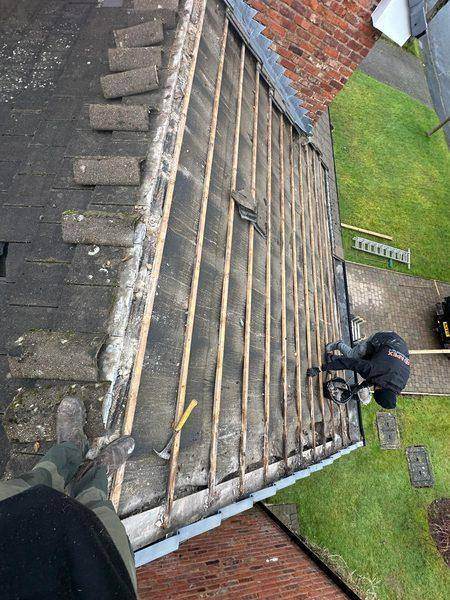
Once the tiles were off, the state of the substructure was plain. The old underlay had torn along the fixing lines and was letting moisture straight through rather than carrying it down to the gutter. Battens that had been damp for years had gone spongy round the nails, and a batten that will not hold a nail will not hold a tile either.
Lead is the other thing that quietly gives up. Where a roof runs into a brick wall, the water is beaten by a flashing worked into the joints of the brickwork and dressed down over the tiles. When that lead splits, lifts out of its joint or has been sealed up with mastic by somebody in a hurry, water gets behind it and runs into the roof at exactly the point you cannot see from the ground.
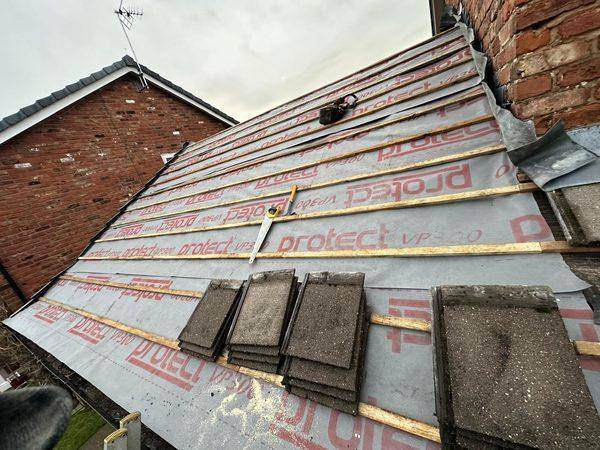
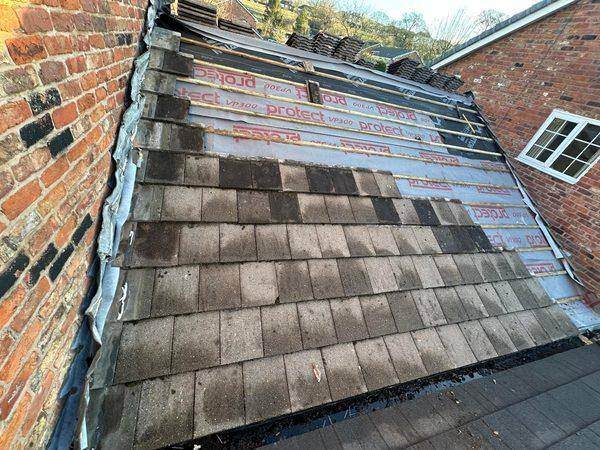
A breathable underlay went down first, run out across the slope and lapped so every sheet drains onto the one below it. You can see the printed face of it in two of the photographs, with fresh sawn battens screwed down over the top and the plain tiles stacked in small piles along the slope waiting to go back. Working in stacks like that keeps the weight spread and stops anyone carrying tiles further than they need to.
Tiles then went back up the roof course by course and were fixed as they went. Where one was cracked or had lost a nib it was swapped out. The photographs of the lower courses relaid show the finish lining up with what was already there, which matters on a small roof against a house wall where everything is seen at once.
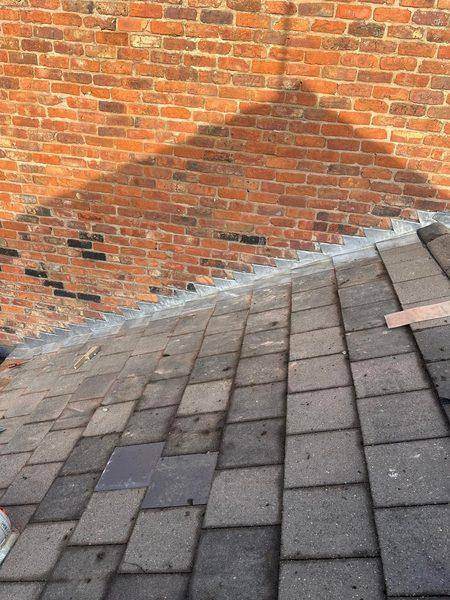
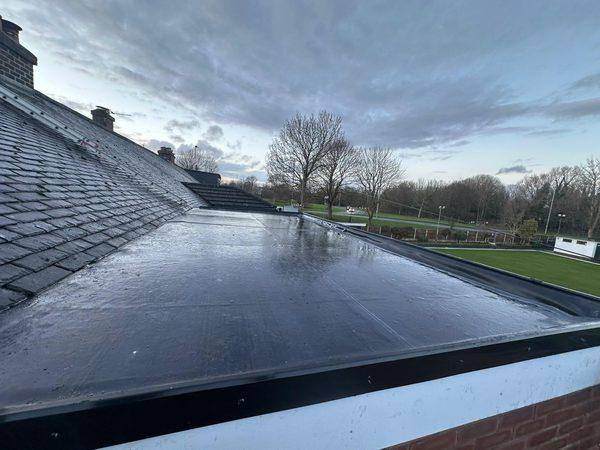
The leadwork was renewed where the roof meets the brickwork. Lead is cut to step with the courses of brick, worked into the bed joints and dressed down over the tiles so water runs out onto the roof and away, not into the wall. The sunlit photograph shows that stepped line finished, each piece sitting into its own joint rather than being run in a straight cut across the face of the brick.
Done properly it is the longest-lived part of a pitched roof, which is why we would rather renew it than patch it. There is more on our leadwork page and on the leadwork in Warrington page, and a related job where a leaking kitchen roof needed the same felt, batten and lead work. To have yours looked at, drop us a line for a free quote.
Tell us what the roof is doing and roughly where you are. We will come and look, and you get a written price before anything starts.