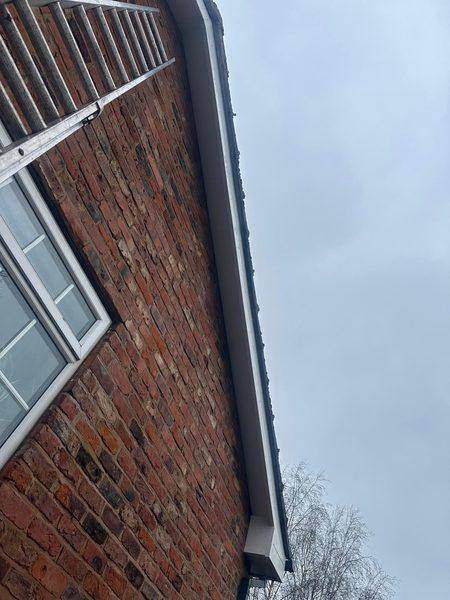
White UPVC fascia, soffit and black half-round gutter on a Warrington roofline
A Warrington roofline in white UPVC fascia and soffit with black half-round guttering, fitted to an older red-brick gable. Photograph of the finished run.
On a gable-ended house, the bargeboard runs up the sloping edge of the roof. It does the job the fascia does at the eaves, and it suffers the same weather.
A bargeboard, sometimes called a verge board, fixes to the end of a gable roof along the sloping edge. It protects the ends of the timbers, closes the edge and gives a finished look. On some older houses bargeboards are decorative, with shaped edges.
uPVC bargeboards resist rot and need no painting. They are usually fitted with a matching soffit beneath. As with fascias, the new board is only as good as what it is fixed to, so the timbers behind are checked and renewed if needed.
Bargeboards at the gable are more exposed than eaves boards, with wind pulling at the edge. Secure fixing matters, and joints must be cut and sealed with care.
Working at the gable end often means access equipment because of the height. The old board is removed, carefully if the tiles or verge mortar above are to be kept. The structure behind is checked, and new boards are cut to the angle of the roof, joined at the apex and fixed.
At the apex, the join is the visible detail, so it is cut to fit tightly and trimmed with a cap or finial if needed.
The verge, where tiles meet the gable edge, was traditionally sealed with mortar. Where mortar has failed, dry verge systems use caps screwed to the batten ends, with no mortar at the edge. A job we photographed in Warrington had grey dry verge caps over white uPVC bargeboards on both sides of a gable. If the verge and bargeboard are both tired, doing both together saves repeat access.
Decorative bargeboards on older houses may be part of the character of the building. If the property is listed or in a conservation area, there may be rules on the materials and appearance. Check with the council before changing them.
Wind exposure should also be mentioned. Gables on open ground or hillsides take the full force of the wind, and loose boards can lift or rattle. Secure fixing into sound timber, together with sealed joints, helps the new boards stay put.
There is also the question of the soffit under the bargeboard, which on some gables is small and tucked into a narrow overhang. It should be checked at the same time, because the same dampness that rotted the board may have affected it. The two parts work together and usually match in profile and colour.
Some questions are worth putting to any roofer before you agree to the work.
If you would like your roofline looked at, call Apex Roofing to arrange a free quotation. We will tell you what we find, what needs replacing and what, if anything, can be left alone.
Call or message Apex Roofing for a free quotation.
A fascia runs along the eaves. A bargeboard runs up the sloping edge of a gable. They do similar jobs in different places.
Yes. Many roofers fit uPVC bargeboards and dry verge caps together for a mortar-free edge.
If the property is listed or in a conservation area, you may. Check with your council.
Real jobs photographed by Apex Roofing.
A Warrington roofline in white UPVC fascia and soffit with black half-round guttering, fitted to an older red-brick gable. Photograph of the finished run.
Apex Roofing covers Cheshire and the surrounding area. Choose your town for local information.
Apex Roofing Cheshire · 5 Weybridge Close, Warrington WA4 5LZ
Tell us about the property and what you have noticed and we will come back to you.
Prefer to talk? Call 07377 461095 · WhatsApp +44 7465 861265 · Email apexroofing14@gmail.com