
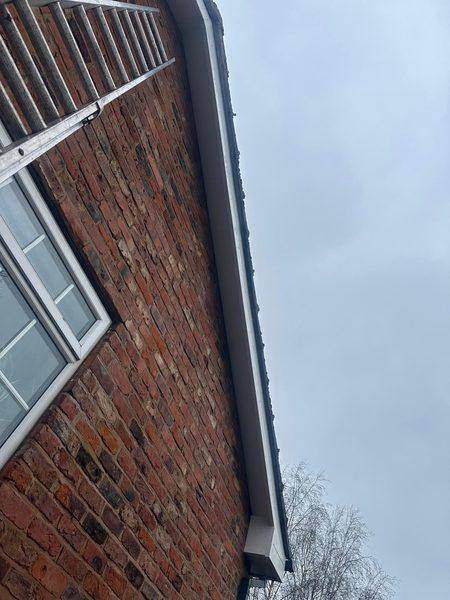
White UPVC fascia, soffit and black half-round gutter on a Warrington roofline
A Warrington roofline in white UPVC fascia and soffit with black half-round guttering, fitted to an older red-brick gable. Photograph of the finished run.
The soffit is the panel you see when you look up at the underside of the roof overhang. It keeps weather and pests out of the roof space, and it is easy to ignore until it fails.
Where the roof overhangs the wall, the underside needs closing off. The soffit does that. It stops rain being blown into the roof space, keeps birds and insects out, and gives the eaves a finished look. In many roofs it also provides a route for air to move into the loft, which is covered in a separate article.
Timber soffits sit under the eaves, where damp air, leaking gutters and dripping water do their worst. Over the years they sag, split, stain and rot. Soffits made from asbestos-containing board were used in some older houses, and a damaged or suspect board needs specialist advice before anything is touched.
uPVC soffit panels come as flat boards or in tongue-and-groove lengths. They are cut to fit the overhang and fixed to a supporting framework or to the rafters. They do not rot and do not need painting. Vented types let air in, and solid types close the gap completely.
The old soffit is taken down, and the support timbers are checked. Where the overhang is wide, a new supporting bearer is fixed to the wall and the rafters so the panels do not sag. The new panels are cut to length, fixed and joined, and corner pieces are fitted where the soffit turns.
Fascias are normally fitted at the same time. The two work together, with the fascia holding the front of the soffit and the gutters. Doing them separately can mean disturbing finished work.
A missing soffit panel lets water and animals into the roof space. Wasps and birds can nest in gaps, and rain can reach timber that should stay dry. Replacing the soffit is as much about protecting the roof as it is about appearance.
Access is the other practical point. Soffits are reached from a ladder, tower or scaffold, and the longer the run the more it makes sense to have proper access equipment in place, so that the panels can be fixed accurately and without rushing.
The choice of finish is mostly about looks. Plain white boards are the most common, and wood-effect and other colours are made for people who want to match window frames. Wide overhangs sometimes look better with a deeper panel, and a roofer can show you samples before you decide.
Some questions are worth putting to any roofer before you agree to the work.
If you would like your roofline looked at, call Apex Roofing to arrange a free quotation. We will tell you what we find, what needs replacing and what, if anything, can be left alone.
Call or message Apex Roofing for a free quotation.
No. They close off the roof edge, keep out weather and pests and often form part of the roof ventilation.
Sometimes, but the two are connected, and doing them together usually gives a tidier, more secure result.
Do not break or drill them. Have them assessed by a suitably qualified person before any work.
Real jobs photographed by Apex Roofing.
A Warrington roofline in white UPVC fascia and soffit with black half-round guttering, fitted to an older red-brick gable. Photograph of the finished run.
Apex Roofing covers Cheshire and the surrounding area. Choose your town for local information.
Apex Roofing Cheshire · 5 Weybridge Close, Warrington WA4 5LZ
Tell us about the property and what you have noticed and we will come back to you.
Prefer to talk? Call 07377 461095 · WhatsApp +44 7465 861265 · Email apexroofing14@gmail.com