
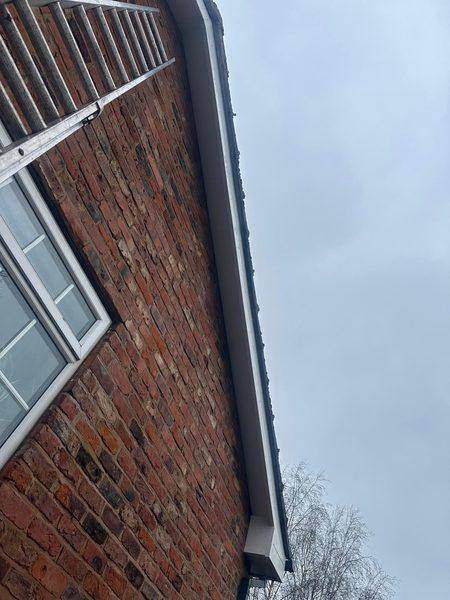
White UPVC fascia, soffit and black half-round gutter on a Warrington roofline
A Warrington roofline in white UPVC fascia and soffit with black half-round guttering, fitted to an older red-brick gable. Photograph of the finished run.
A roof space needs air moving through it. In many houses the soffit is where that air comes in. Replace it with a solid panel and you could make a quiet problem.
Warm, moist air from the house rises into the roof space. If it cannot escape, it condenses on cold surfaces such as the underside of the roof covering and the timbers. Over time that leads to damp, mould and rot. Moving air carries moisture away.
A vented soffit has gaps or slots that allow outside air to enter at the eaves. The air moves up through the loft and exits at the ridge or through other vents. Together, the inlets at the bottom and outlets at the top keep air flowing.
Not necessarily. It depends on how the roof is built. Some roofs have breathable underlay and are designed to cope in a different way. Others rely on eaves ventilation. Cold lofts with insulation at ceiling level generally need airflow. The right answer depends on the roof construction, so the existing arrangement should be examined before changing it.
A common mistake is replacing a vented soffit with a solid one. The roof loses its inlet, and problems may not show for a while. Another is insulation pushed hard into the eaves, which blocks air even if the vents are open.
When we replace soffits, we look at what ventilation exists and keep it, or improve it where there is a sign it is lacking.
The old soffit is removed and the framing checked. Panels are fixed, with vent sections positioned along the run. The positions are chosen to avoid being blocked by insulation or obstructions in the loft, and the area behind is checked for clear airflow.
Finally, remember birds and insects. Vent openings are small for a reason, and a proper vent panel includes a mesh or narrow slots to stop them getting in. Poorly made gaps in an ordinary soffit can do the opposite and invite nesting.
It is also worth asking what the roof will do in future. If you plan to convert the loft, add insulation or install a new roof covering, the ventilation requirements may change. Mention it before soffits go up, so that the panels you choose will suit the later work and you are not opening them again.
Some questions are worth putting to any roofer before you agree to the work.
If you would like your roofline looked at, call Apex Roofing to arrange a free quotation. We will tell you what we find, what needs replacing and what, if anything, can be left alone.
Call or message Apex Roofing for a free quotation.
Requirements depend on the roof construction. Existing ventilation should not be blocked.
Often, yes. Disc vents or strip vents can be added to a soffit, depending on the existing panels.
Condensation, damp smells, mould on timbers and wet felt can all be signs. A roofer can check.
Real jobs photographed by Apex Roofing.
A Warrington roofline in white UPVC fascia and soffit with black half-round guttering, fitted to an older red-brick gable. Photograph of the finished run.
Apex Roofing covers Cheshire and the surrounding area. Choose your town for local information.
Apex Roofing Cheshire · 5 Weybridge Close, Warrington WA4 5LZ
Tell us about the property and what you have noticed and we will come back to you.
Prefer to talk? Call 07377 461095 · WhatsApp +44 7465 861265 · Email apexroofing14@gmail.com