
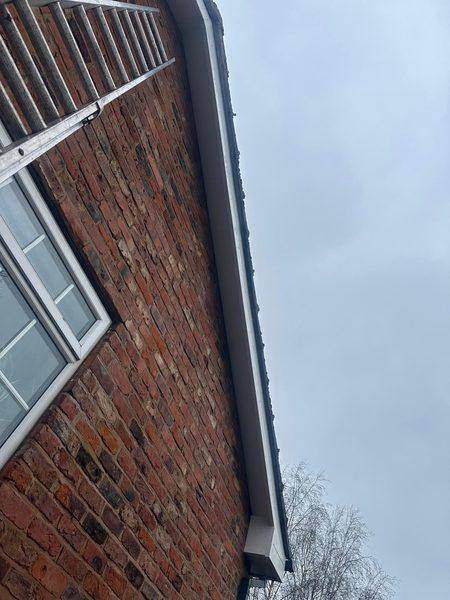
White UPVC fascia, soffit and black half-round gutter on a Warrington roofline
A Warrington roofline in white UPVC fascia and soffit with black half-round guttering, fitted to an older red-brick gable. Photograph of the finished run.
If a loft smells damp, drips on cold mornings or has mould on the timbers, the roof may not be getting enough air. Roofline vents are one of the ways of putting that right.
Everyday life puts moisture into the air in a house, from cooking, washing, drying clothes and breathing. Some of that warm air rises into the loft. If the loft is cold and the air cannot move, the moisture condenses on cold surfaces. Added insulation can make a loft colder, which can make the problem worse if vents are blocked.
Before adding vents, look at how the roof is built. Is there a breathable underlay, or traditional felt? Is the insulation at ceiling level or at the rafters? Are there existing vents at the eaves, the ridge or in the gable? What looks like a ventilation problem can be partly caused by leaks, extractor fans that blow into the loft or gaps around light fittings that let moist air through.
Which one suits depends on the roof. Often a mix of inlets at the eaves and outlets at the ridge gives the best airflow.
Insulation should stop short of the eaves, or be held back with trays, so air can pass over it. Packing insulation tight into the eaves is a very common reason for blocked vents. When soffits are replaced it is the ideal moment to check this.
Because soffits and fascias are open during replacement, adding vents costs little extra effort. If you are replacing the roofline anyway, ask about it. Where condensation is already a problem, say so before the work starts.
Changes to ventilation should be sensible, not excessive. Too little air gives condensation, but a roof can also be over-ventilated, letting in driven rain and snow. The aim is a steady, balanced flow across the roof, which is why the existing arrangement should be understood first.
It may also be sensible to look at the loft hatch and any holes in the ceiling. Warm, moist air leaks through gaps around pipes, cables and downlights and drives much of the condensation people blame on the roof. Sealing those gaps reduces the moisture load, and works hand in hand with any new vents.
Some questions are worth putting to any roofer before you agree to the work.
If you would like your roofline looked at, call Apex Roofing to arrange a free quotation. We will tell you what we find, what needs replacing and what, if anything, can be left alone.
Call or message Apex Roofing for a free quotation.
Condensation, damp smells and mould on the timbers are all signs. A roofer or surveyor can check the loft.
Moving air keeps the loft cold, which is normal. Insulation at ceiling level keeps the house warm.
Often, yes. Disc or strip vents can be added to many uPVC soffits, depending on the construction.
Real jobs photographed by Apex Roofing.
A Warrington roofline in white UPVC fascia and soffit with black half-round guttering, fitted to an older red-brick gable. Photograph of the finished run.
Apex Roofing covers Cheshire and the surrounding area. Choose your town for local information.
Apex Roofing Cheshire · 5 Weybridge Close, Warrington WA4 5LZ
Tell us about the property and what you have noticed and we will come back to you.
Prefer to talk? Call 07377 461095 · WhatsApp +44 7465 861265 · Email apexroofing14@gmail.com