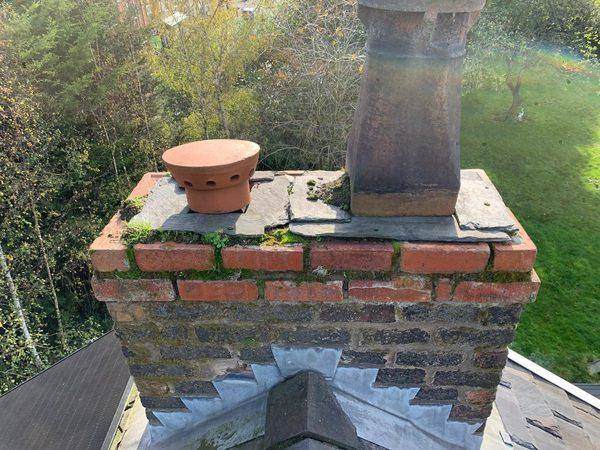
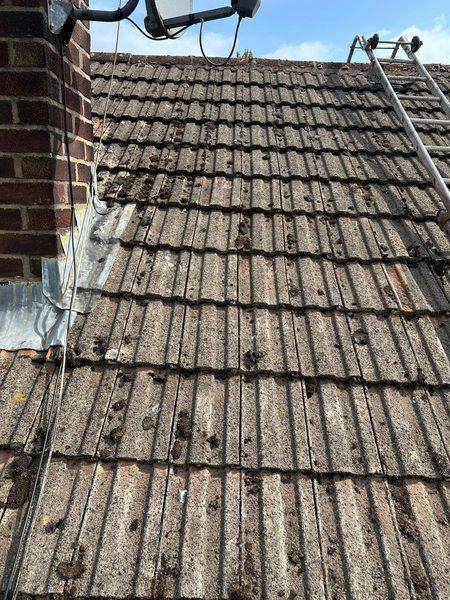
Ridge repointing, chimney leadwork and re-bedded pots in Blackpool
Ridge and hip repointing, chimney leadwork made good and both pots re-bedded on a Blackpool house. Photographs of each stage of the work.
The lead around the base of a chimney is a common source of leaks. It has several separate parts, each doing a different job, and any of them can fail.
Where a chimney comes through a pitched roof, water has to be directed around it. That takes several pieces of lead working together, each tucked into the brickwork and dressed over the roof covering.
Because the junction involves several pieces, a defect in just one can let water in.
The mortar holding the top edge of the lead often crumbles first, which lets the metal lift. Lead can also crack where it has been folded repeatedly or where long runs have expanded and contracted. The back gutter is especially prone to blocking with moss and debris, and then water backs up over its edge.
Past repairs using bitumen strip or sealant may have covered up a problem rather than solved it. Those materials dry out and peel with time.
The old flashing is stripped away and the chases cleaned out. Tiles around the stack are lifted as needed so the new lead can be dressed correctly beneath them. New lead is cut to size, formed to the shape of the stack and roof covering, tucked into the raked-out joints and secured with wedges. The mortar joints are then repointed or sealed appropriately.
A water test afterwards, running water over the junction while someone checks inside, is a practical way to confirm the work is sound.
Lifted lead in good condition might be re-fixed. If the lead is split, thin or a patchwork of earlier fixes, renewal is more dependable. It is usually best to do the flashing and the chimney pointing together if both are in poor shape, since they share the same access.
On older houses, chimneys on the ridge and chimneys on the slope are flashed differently, and a stack at the gable end may only need side flashings. A good roofer will look at how your particular stack meets the roof rather than applying one standard pattern. That is part of why a roof-level inspection is more useful than a guess from the ground.
If you think your chimney flashing is failing, Apex Roofing offers a free inspection and free quotation. Call to discuss what is needed.
Call or message Apex Roofing for a free quotation.
It is a lead channel on the upper side of the stack that catches water running down the roof and carries it around the chimney. When it blocks or fails, leaks often follow.
Sealant can slow a small leak briefly but does not replace correct lead work. It tends to dry out and crack, so a proper repair is usually more dependable.
Damp near the chimney breast after rain, gaps at the base of the stack and lifted lead are common clues. An inspection and sometimes a water test will confirm it.
Real jobs photographed by Apex Roofing.
Ridge and hip repointing, chimney leadwork made good and both pots re-bedded on a Blackpool house. Photographs of each stage of the work.
Mossy mortar raked out of a stone-slated roof in Warrington. The chimney cow was re-bedded and the flaunching renewed, then the whole ridge line was re-pointed.
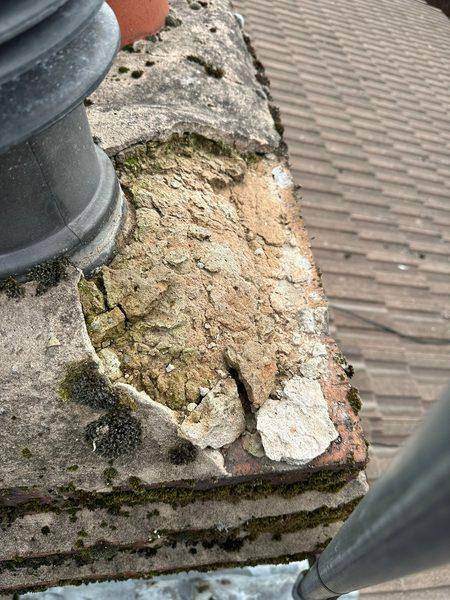
A Warrington chimney crown re-flaunched after the old fillet crumbled away and left the flue terminal unsupported. Photographs of the work.
Apex Roofing covers Cheshire and the surrounding area. Choose your town for local information.
Apex Roofing Cheshire · 5 Weybridge Close, Warrington WA4 5LZ
Tell us about the property and what you have noticed and we will come back to you.
Prefer to talk? Call 07377 461095 · WhatsApp +44 7465 861265 · Email apexroofing14@gmail.com