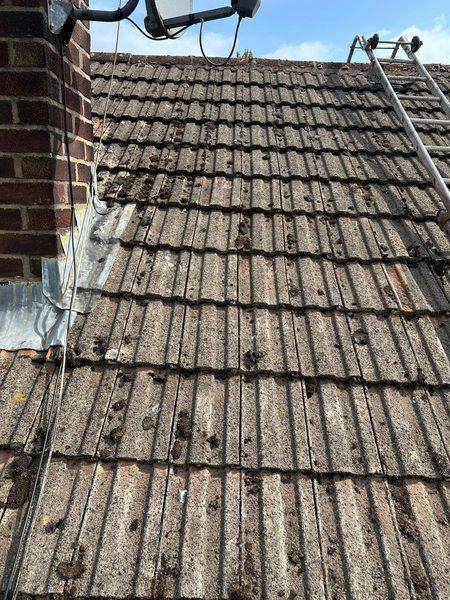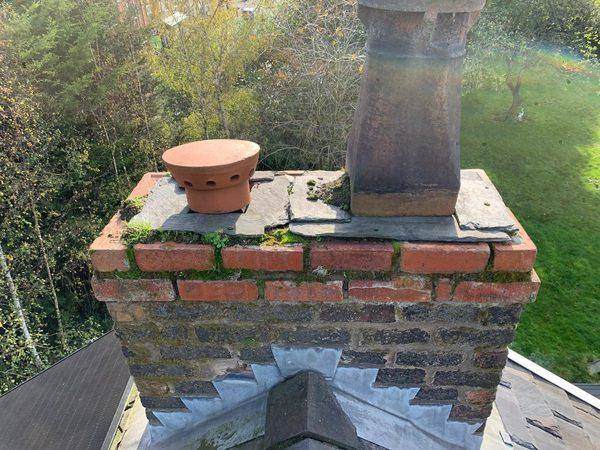
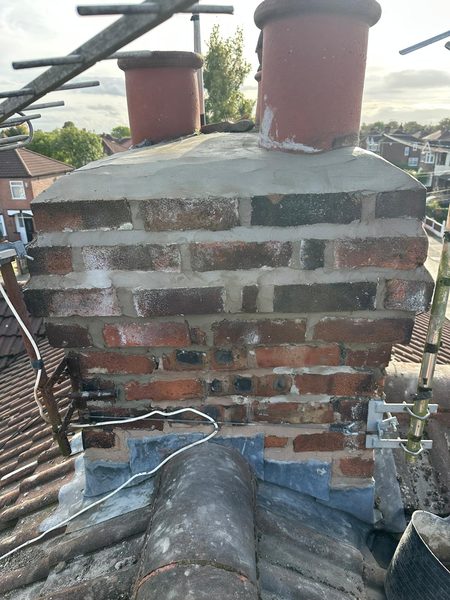
A small chimney stack rebuilt and re-flaunched in Salford
A Salford chimney stack with moss and a fern growing from the top, rebuilt and re-flaunched. Photographs of the work.
A chimney stack that is cracked, leaning or shedding bricks is a safety matter as well as a leak risk. Here is how problems develop and what repairing a stack involves.
Brick and stone are tough, but a stack is a tall, thin structure standing in the wind. Over many winters, water works into the joints and the bricks, frost splits them and the stack slowly loses strength. Flue gases can also attack the inside of the brickwork, particularly where the lining has failed.
Movement is another factor. If the stack is not tied well into the building, or the supporting walls shift, cracks can open up.
A lean in particular should be looked at quickly. If the stack seems unstable, keep clear of the area beneath it and call a roofer to inspect.
The roofer looks at the stack from a safe working position, ideally with scaffolding or a platform. They check the brickwork, joints, flaunching, pots, flashing and the junction with the roof. They may also look at the chimney breast in the loft and rooms below for damp, cracking or shifting.
Minor damage can be repaired in place. Individual cracked or spalled bricks can be cut out and replaced, loose masonry re-bedded, and open joints repointed with a suitable mortar. Cracks may be stitched or repaired where the cause is understood.
If the upper part of the stack is in poor condition, the usual repair is to take it down to sound brickwork and rebuild it, reusing good bricks and matching replacements. The pots, flaunching and flashing are then re-set at the same time.
Bricks and mortar on older properties are often different from modern ones. A rebuilt stack should look like the original, so a roofer will try to match brick size, colour and bonding. Sourcing reclaimed bricks may help on older homes, depending on availability.
Cracking that runs down into the chimney breast, or movement in the wall below the stack, may mean a wider structural issue. In that case, a structural surveyor's opinion may be sensible. A roofer should be willing to say when something is beyond a roof repair.
Internal signs matter as much as external ones. Flaking plaster, a musty smell, wallpaper lifting on the chimney breast or soot staining in an unused room can all point to water or flue gases getting somewhere they should not. If you notice these alongside a worn stack, mention them when you ask for an inspection.
If your chimney stack is showing cracks or movement, Apex Roofing can inspect it and give a free quotation. Call to talk it through.
Call or message Apex Roofing for a free quotation.
It can be. A leaning stack may be unstable and could shed bricks. Keep clear of the area beneath it and have it inspected promptly by a roofer.
Yes. Individual bricks can often be cut out and replaced, provided the surrounding masonry is sound. Widespread damage may point to rebuilding the affected section.
Possible causes include failed flashing, porous brickwork, open mortar joints or a defective top to the stack. An inspection identifies which applies.
Real jobs photographed by Apex Roofing.
A Salford chimney stack with moss and a fern growing from the top, rebuilt and re-flaunched. Photographs of the work.
Ridge and hip repointing, chimney leadwork made good and both pots re-bedded on a Blackpool house. Photographs of each stage of the work.
Mossy mortar raked out of a stone-slated roof in Warrington. The chimney cow was re-bedded and the flaunching renewed, then the whole ridge line was re-pointed.
Apex Roofing covers Cheshire and the surrounding area. Choose your town for local information.
Apex Roofing Cheshire · 5 Weybridge Close, Warrington WA4 5LZ
Tell us about the property and what you have noticed and we will come back to you.
Prefer to talk? Call 07377 461095 · WhatsApp +44 7465 861265 · Email apexroofing14@gmail.com