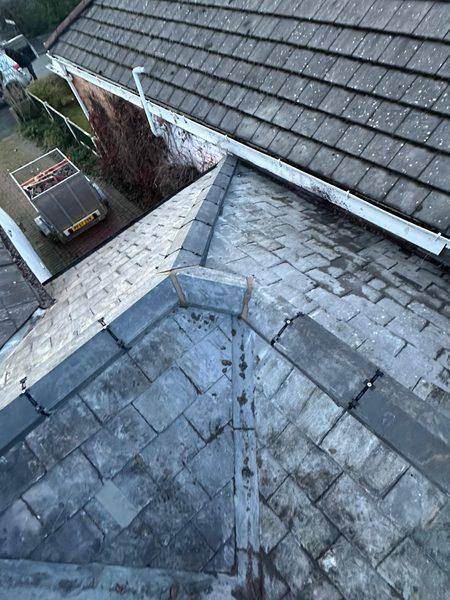
A moss-filled mortar valley replaced with a preformed dry valley in Warrington
A mortar valley choked with moss replaced by a preformed dry valley in Warrington, with the slope re-covered on new underlay and battens either side of the line.
A continuous dry verge uses a long run of trim along the gable, fixed to the roof edge, rather than separate pieces. Here is where it suits and how it is installed.
In a continuous dry verge, a long section of trim is fixed along the edge of the roof, covering the end of the tiles and the top of the gable wall. It is cut to length on site and joined as needed. Because it is one run rather than individual units, it offers a clean, uniform line.
It is often used on flatter tile profiles, or where several lengths can be made to look like one.
On roofs with deep profiles, a continuous trim may leave gaps unless the system includes suitable filler pieces. That is something to check before a system is chosen.
The trim needs to be fixed at the right spacing. Too few fixings leaves it prone to lifting in strong wind.
Thermal movement is another reason to ask about joints. Long runs of any material expand and shrink a little with temperature, so a good installation leaves allowance for it rather than pinning everything rigidly. Rattling or buckling along a long gable usually points to that being overlooked.
Tile profile, gable length, exposure and how much movement there is in the roof edge all influence the choice. A long, exposed gable may need extra fixings. A very short one may suit individual units better.
Appearance is a factor too. A continuous trim can look slightly different from a traditional tiled edge, so it is worth asking to see a sample or photograph before deciding.
If the roof is old and the tiles are brittle, a verge system alone will not help. If the gable wall is cracked or the bargeboards are rotten, those must be dealt with first. In some cases, a bedded verge with proper pointing may suit the roof or the building better, especially where the property is in a conservation area or listed and appearance is controlled.
Ask what system is proposed, how it is fixed, where joints will fall and what is being done about timber. For a continuous dry verge, we offer a free survey and a free quotation.
Call or message Apex Roofing for a free quotation.
A uniform line along the gable and, on some tile profiles, a neater fit than separate units. Whether it is the best choice depends on your tiles.
No. It must be designed for the tile profile and roof edge. A roofer can check this at survey.
Joints are normally lapped or covered according to the product design. The details vary, so ask which method will be used.
Real jobs photographed by Apex Roofing.
A mortar valley choked with moss replaced by a preformed dry valley in Warrington, with the slope re-covered on new underlay and battens either side of the line.
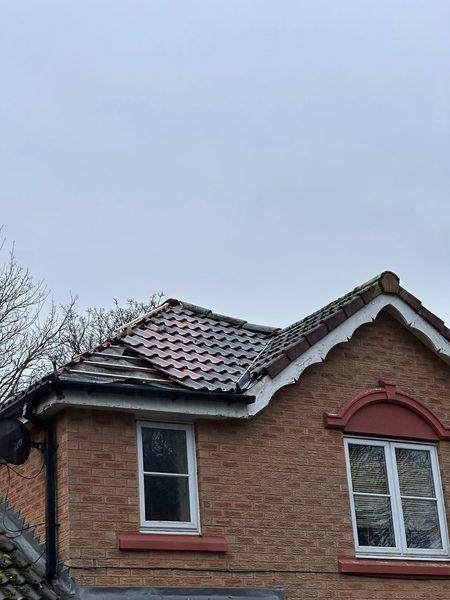
Crumbling red clay ridge and hip tiles lifted off a Warrington roof and replaced with new grey ridge tiles on a mechanically fixed dry ridge system.
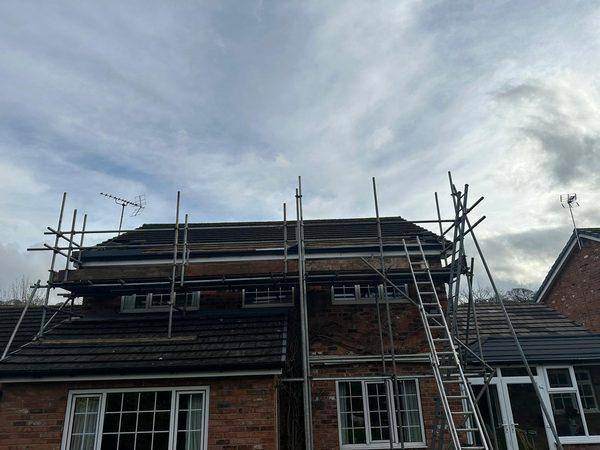
A Macclesfield roof stripped back, re-felted on a breathable membrane, re-battened and finished with a dry ridge kit. Photographs of the work.
Apex Roofing covers Cheshire and the surrounding area. Choose your town for local information.
Apex Roofing Cheshire · 5 Weybridge Close, Warrington WA4 5LZ
Tell us about the property and what you have noticed and we will come back to you.
Prefer to talk? Call 07377 461095 · WhatsApp +44 7465 861265 · Email apexroofing14@gmail.com