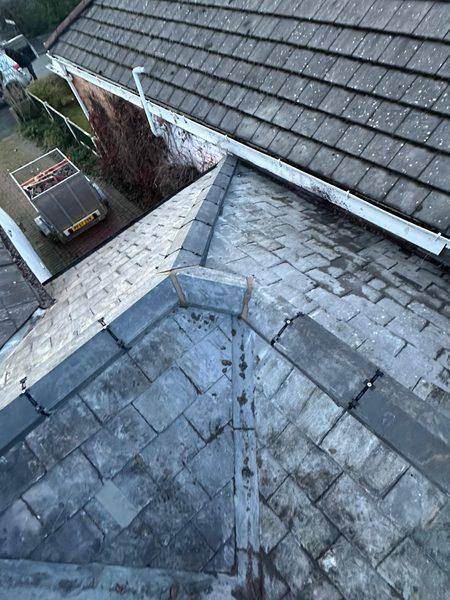
A moss-filled mortar valley replaced with a preformed dry valley in Warrington
A mortar valley choked with moss replaced by a preformed dry valley in Warrington, with the slope re-covered on new underlay and battens either side of the line.
The ends of a dry verge are where a neat job is made or spoilt. Caps, ridge ends and junction pieces seal the system and keep wind and water out.
A dry verge looks simple along its length, but the ends need extra pieces to finish them properly. At the top, the verge meets the ridge. At the bottom, it meets the eaves and gutter. In between, there may be joints or junctions where one component meets another.
These finishing pieces seal the system, tidy the edge and stop wind and water from getting underneath. They are often the first parts to get damaged or go missing.
The exact pieces depend on the system and tile. Some are made of plastic or a similar material, others in fibre cement or the same material as the tiles.
A missing end cap at the ridge leaves the ridge open. A gap at the bottom of the verge lets wind lift the first tiles. A cracked junction piece may let water run back into the roof. From the ground you might see a ragged line at the top or bottom of the gable, or a piece lying in the garden.
Neatness at the ends is also a sign of care across the whole job. When you look at finished work, check that the end pieces sit square, that cut edges are tidy and that nothing looks forced into place. Photographs taken at the end of a job are a good way to record this.
In most cases the work is small, but it does involve working at height, so it is best left to a roofer.
Different systems use different end pieces, and parts for older products are not always available. Where an exact match cannot be found, a close alternative may be used. We would explain that before starting.
Colour is another matter. A new cap on an old roof may look slightly different at first, though it usually weathers in.
If several finishing pieces have gone, the system may be wearing out, or the fixing method may be wrong. In that case a wider repair or renewal of the verge is the sensible route. Ask whether the roofer has checked the whole run and what they will fit.
If you can see a missing cap or a gap at the end of your verge, call to arrange a free inspection and a free quotation.
Call or message Apex Roofing for a free quotation.
It is a piece that closes off the end of a verge or ridge run, usually at the top or bottom, to keep wind and water out and give a tidy finish.
It can let wind and rain in at the ridge or eaves. Whether that causes a leak depends on the roof, so it is worth having checked.
For current systems usually yes. For older ones, a close match may be needed, which a roofer can advise on.
Real jobs photographed by Apex Roofing.
A mortar valley choked with moss replaced by a preformed dry valley in Warrington, with the slope re-covered on new underlay and battens either side of the line.
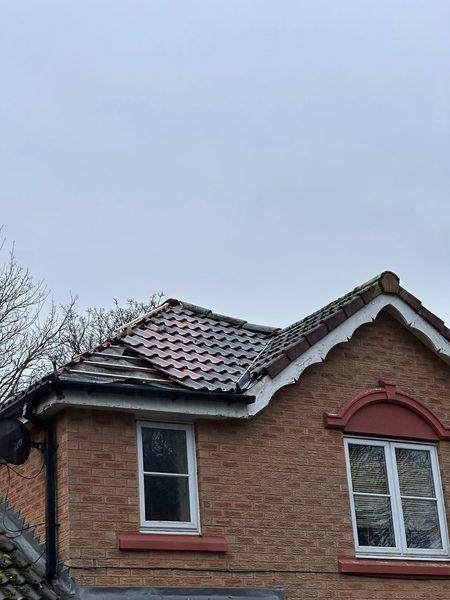
Crumbling red clay ridge and hip tiles lifted off a Warrington roof and replaced with new grey ridge tiles on a mechanically fixed dry ridge system.
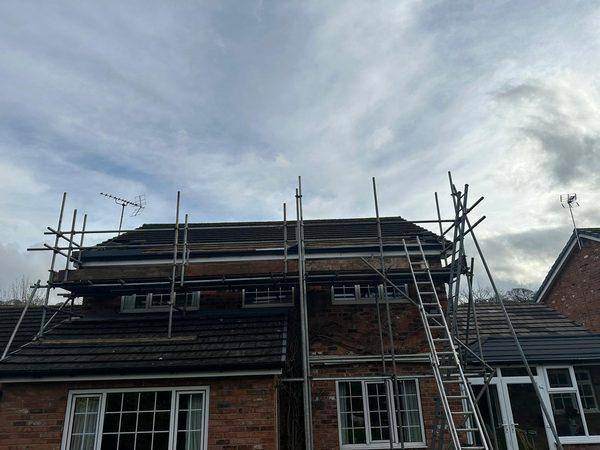
A Macclesfield roof stripped back, re-felted on a breathable membrane, re-battened and finished with a dry ridge kit. Photographs of the work.
Apex Roofing covers Cheshire and the surrounding area. Choose your town for local information.
Apex Roofing Cheshire · 5 Weybridge Close, Warrington WA4 5LZ
Tell us about the property and what you have noticed and we will come back to you.
Prefer to talk? Call 07377 461095 · WhatsApp +44 7465 861265 · Email apexroofing14@gmail.com