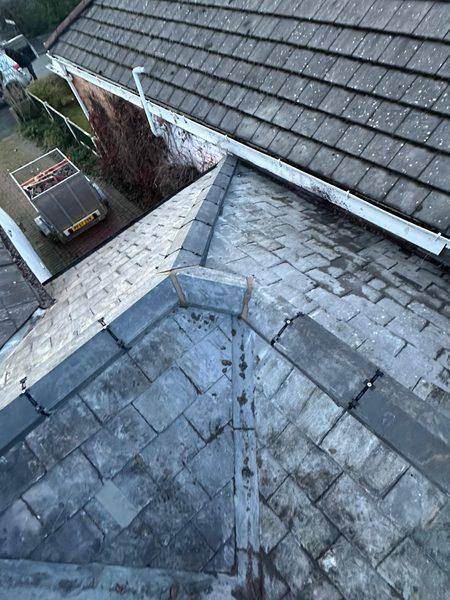
A moss-filled mortar valley replaced with a preformed dry valley in Warrington
A mortar valley choked with moss replaced by a preformed dry valley in Warrington, with the slope re-covered on new underlay and battens either side of the line.
Dry verge is designed to last, but caps can work loose and badly fitted systems can fail. Here is how problems are spotted and put right. Small faults are best caught early.
A dry verge should stay put without mortar, but it is only as good as its fixings and the roof edge underneath. Wind, age and poor fitting can all cause trouble. A cap or unit may lift, a clip may fail, or the batten behind may rot and no longer hold a screw.
It is easy to assume that a dry system never needs attention. In reality, an occasional check is sensible, especially after a very windy spell.
Some of these are obvious from the ground. A missing cap leaves a visible gap against the sky, and a lifted unit may show a different line from its neighbours.
Before replacing a part, it is worth finding out why it failed. If a single cap was knocked, replacing it is simple. If several are loose, the batten ends may be rotten or the fixing method wrong. If the system was fitted incorrectly in the first place, patching will not solve it.
If you are not sure what you are looking at, take a photograph from the ground with a zoom lens, or ask a roofer to send photographs from the roof. That gives you something to compare when quotes arrive and shows whether the fault is one piece or the whole run. Keep any fallen pieces, because they help identify the product.
If the original product is no longer made, a close alternative may be needed. Colour and shape can vary slightly, which we explain before starting.
Age, exposure and the type of system installed all matter. A recently fitted verge with one damaged cap is a small job. A verge that is ten or twenty years old, with fixings failing along its length, may justify a more complete renewal.
Working at height is involved, so scaffolding or a safe access system may be needed on higher gables.
If the roof edge is rotten or the gable wall has moved, the verge cannot hold. In that case, the structure needs attention first. Ask any roofer what they have found, what they plan to replace and whether the system matches your tile profile.
If you can see loose or missing verge pieces on your roof, call to arrange a free inspection and a free quotation.
Call or message Apex Roofing for a free quotation.
It is worth getting it looked at soon, because an open verge can let wind and rain get under the tiles. Call to discuss current availability.
Working at height is risky, and the fixing needs to go into sound timber. It is better left to a roofer who can check what lies beneath.
Loose screws, failed clips or rotten battens are the usual causes. They tend to get worse in wind, so it is better to deal with them early.
Real jobs photographed by Apex Roofing.
A mortar valley choked with moss replaced by a preformed dry valley in Warrington, with the slope re-covered on new underlay and battens either side of the line.
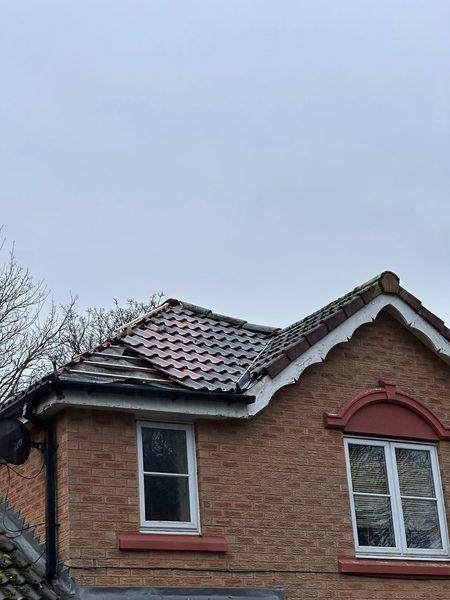
Crumbling red clay ridge and hip tiles lifted off a Warrington roof and replaced with new grey ridge tiles on a mechanically fixed dry ridge system.
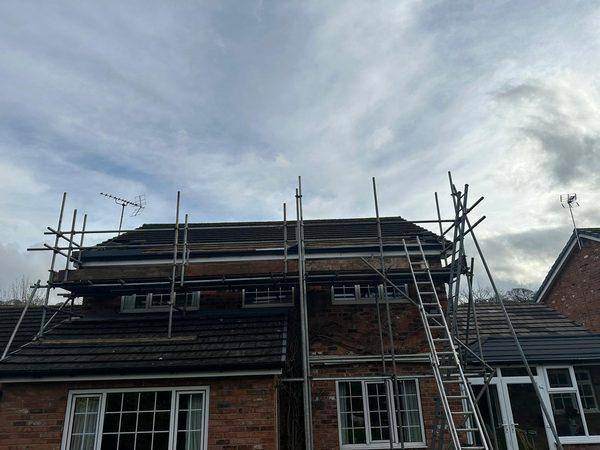
A Macclesfield roof stripped back, re-felted on a breathable membrane, re-battened and finished with a dry ridge kit. Photographs of the work.
Apex Roofing covers Cheshire and the surrounding area. Choose your town for local information.
Apex Roofing Cheshire · 5 Weybridge Close, Warrington WA4 5LZ
Tell us about the property and what you have noticed and we will come back to you.
Prefer to talk? Call 07377 461095 · WhatsApp +44 7465 861265 · Email apexroofing14@gmail.com