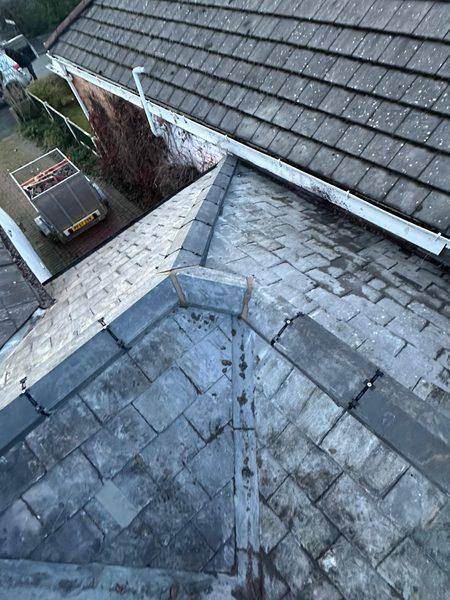
A moss-filled mortar valley replaced with a preformed dry valley in Warrington
A mortar valley choked with moss replaced by a preformed dry valley in Warrington, with the slope re-covered on new underlay and battens either side of the line.
Individual dry verge units are made to match particular tile profiles and interlock along the gable. Here is what they are, how they are fitted and when they suit.
Individual dry verge units are separate pieces, each shaped to fit a particular tile profile. They sit side by side along the gable edge, overlapping or interlocking so that the joint between each one is covered. Each unit is fixed down to the roof batten.
They contrast with continuous systems, where a long run of trim is cut to length. Units usually follow the rhythm of the tiles, so they tend to look closer to a traditional tiled edge.
The trade-off is that they must match the tile you have. If there is no suitable unit for your tile, another system may be needed.
Care is taken at the first and last units, which often need cutting. A badly cut end unit stands out more than any other part of the verge.
Wind is the main test of any verge, so the fixing schedule matters. A good installer will tell you how many fixings each unit gets and whether the edge tiles are also clipped or screwed. If the answer is vague, ask again. It is much easier to discuss before the work than after a storm.
Tile profile, exposure and the roof pitch all play a part. On a very exposed gable, the fixing method needs particular attention. On a roof with unusual or older tiles, individual units may not be available, and a continuous system or a bedded verge could suit better.
Colour matters too. The unit is made in a limited range, so the match to existing tiles should be discussed in advance.
If the batten ends are rotten, the gable wall is loose or the roof has other problems, individual units will not fix them. A roofer should look at the entire edge, not just the part that shows. Where tiles are very old, it may also be worth considering how long the rest of the roof will last before investing in the edge.
Ask what product is proposed, how it will be fixed and what happens at the ridge. If you would like individual dry verge units looked at for your roof, we offer a free survey and a free quotation.
Call or message Apex Roofing for a free quotation.
Neither is better in every case. Units follow the tile profile and can be replaced one by one, while continuous systems suit some roofs more neatly. It depends on your tiles.
Often yes, if a matching unit is available and the fixings behind it are sound.
Not usually. The edge tiles may be adjusted or replaced, but the main roof can stay as it is if it is in good condition.
Real jobs photographed by Apex Roofing.
A mortar valley choked with moss replaced by a preformed dry valley in Warrington, with the slope re-covered on new underlay and battens either side of the line.
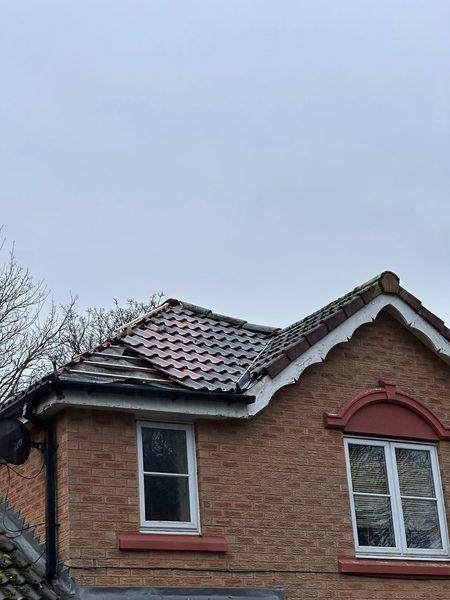
Crumbling red clay ridge and hip tiles lifted off a Warrington roof and replaced with new grey ridge tiles on a mechanically fixed dry ridge system.
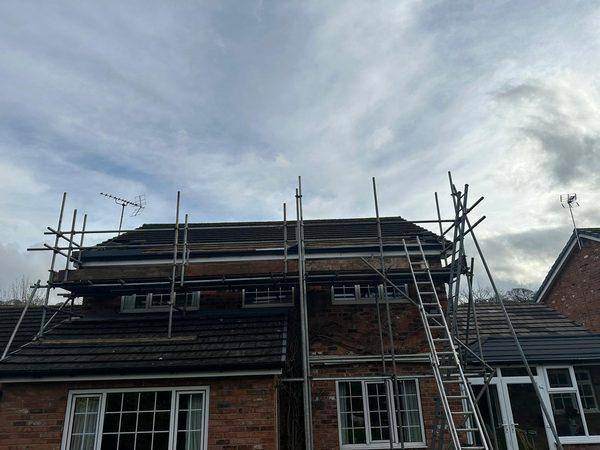
A Macclesfield roof stripped back, re-felted on a breathable membrane, re-battened and finished with a dry ridge kit. Photographs of the work.
Apex Roofing covers Cheshire and the surrounding area. Choose your town for local information.
Apex Roofing Cheshire · 5 Weybridge Close, Warrington WA4 5LZ
Tell us about the property and what you have noticed and we will come back to you.
Prefer to talk? Call 07377 461095 · WhatsApp +44 7465 861265 · Email apexroofing14@gmail.com