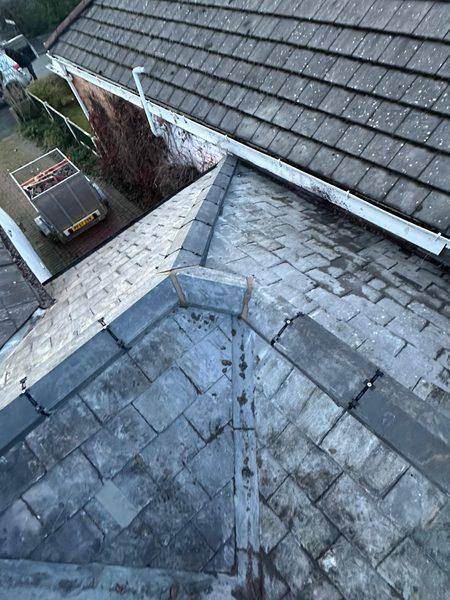
A moss-filled mortar valley replaced with a preformed dry valley in Warrington
A mortar valley choked with moss replaced by a preformed dry valley in Warrington, with the slope re-covered on new underlay and battens either side of the line.
A dry verge finishes the gable edge of a tiled roof with fixings and caps instead of mortar. Here is how it is installed and what decides whether it suits your roof.
The verge is the sloping edge of a roof at a gable end, where the tiles stop above the gable wall. Traditionally the gap is filled with mortar, with the tiles bedded into it. A dry verge replaces that mortar with a mechanically fixed system: a batten or cleat to hold the edge tiles and a cap or unit that covers the exposed ends.
The aim is a roof edge that stays tidy without depending on mortar that cracks and falls out over the years.
A dry verge is not magic. It needs sound tiles, battens and bargeboards behind it, and it will not cure a roof that is leaking for other reasons.
The details depend on the roof. On some roofs a verge cleat is required to give the tile edge firm support. On others, an undercloak of fibre cement or a similar board forms the base. These choices follow from the tile type and what is already there.
Colour matching is another factor. Dry verge components come in a limited range of colours, so a close match to your existing tiles may be possible but is not always exact. On a visible gable it is worth discussing before you commit.
If your property is listed or in a conservation area, the external appearance of the roof edge may matter to the council, so check before work starts.
If the tiles are old and brittle, if the batten ends are rotten or if the gable wall is crumbling, the first job is to deal with those. Fitting a new verge to poor foundations is a false economy. A roofer should tell you what needs doing and why.
Ask what system is proposed, how it is fixed, what happens at the ridge and whether any timber repairs are included. If you are thinking about a dry verge, we offer a free survey and a free quotation.
Call or message Apex Roofing for a free quotation.
Not always. It depends on the tile type, the gable construction and whether the system is made for that profile. A survey is the way to find out.
It generally needs less maintenance than mortar, but the roof should still be checked now and then for slipped tiles, loose caps or debris.
Components come in set colours and profiles. A good match is often possible, though a perfect match cannot be promised, especially on weathered tiles.
Real jobs photographed by Apex Roofing.
A mortar valley choked with moss replaced by a preformed dry valley in Warrington, with the slope re-covered on new underlay and battens either side of the line.
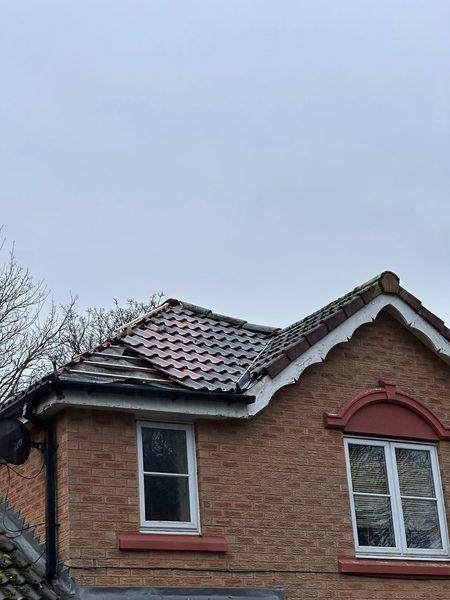
Crumbling red clay ridge and hip tiles lifted off a Warrington roof and replaced with new grey ridge tiles on a mechanically fixed dry ridge system.
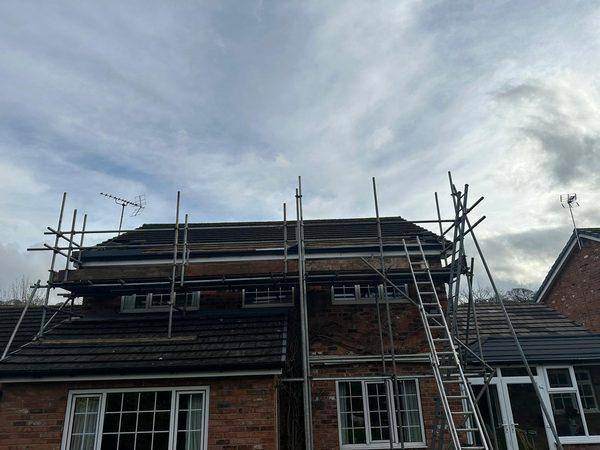
A Macclesfield roof stripped back, re-felted on a breathable membrane, re-battened and finished with a dry ridge kit. Photographs of the work.
Apex Roofing covers Cheshire and the surrounding area. Choose your town for local information.
Apex Roofing Cheshire · 5 Weybridge Close, Warrington WA4 5LZ
Tell us about the property and what you have noticed and we will come back to you.
Prefer to talk? Call 07377 461095 · WhatsApp +44 7465 861265 · Email apexroofing14@gmail.com