
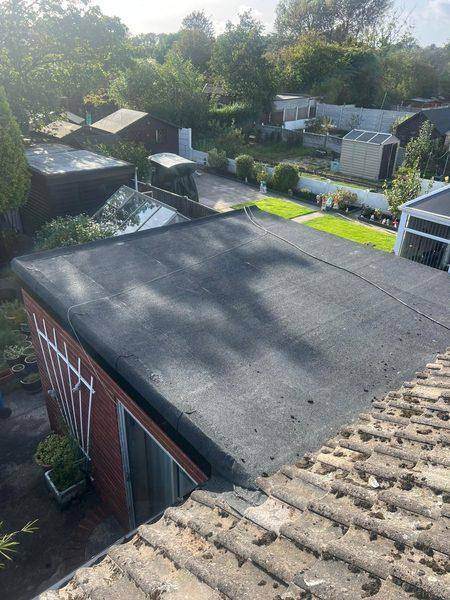
A rotten deck replaced and covered in torch-on felt in Warrington
A leaking flat roof in Warrington taken off to the joists, re-decked in exterior-grade plywood and covered in torch-on felt. See the photographs.
A dormer has a small flat roof with a lot of edges. This guide explains how it is waterproofed, where leaks start and what to ask before the work begins.
A dormer is a structure that projects from a pitched roof to add headroom and a window. Many have a flat or near-flat top. Although the area is small, the roof has several sides, a joint with the main roof and a lot of corners, so it needs more care than its size suggests.
Because dormers are high up and often out of sight, problems can go unnoticed until water appears on a bedroom ceiling.
The covering on the flat top may be EPDM, GRP or reinforced felt. Each can work, but because of the shape and the access, the choice often turns on how the edges can be finished and what the roof structure will take.
Leaks rarely come from the middle of the covering. They usually start at the upstand where the flat roof meets the cheek, at the top of the window frame, or in the valley and flashing where the dormer meets the main roof. Lead flashing is often used in those spots, and the quality of the dressing matters.
Dormers also move more than people expect. Timber shrinks and swells with the seasons, which puts stress on the joints where different materials meet. Sealant alone rarely deals with that. A good dormer roof allows for a little movement, using flexible membranes and well-dressed flashings rather than hard fillers.
Poor drainage is another cause. A small flat top with a blocked gutter will hold water against the front edge.
The old covering is stripped and the deck inspected. Dormer structures are often built from timber, so rot at the edges is common. Damaged timber is repaired, the deck is made ready with suitable falls, and the new covering is laid and dressed up the cheeks.
Edge trims and the gutter are fitted, and the junction with the main roof is checked and resealed or reflashed. Insulation may be added if the room below is being improved, subject to what the structure allows.
A small split or a lifted flashing can sometimes be put right. If the timber is soft, the cheeks are letting in water, or the covering has failed overall, a repair is only temporary. Replacing the covering and repairing the structure is the more reliable route.
We work on dormer flat roofs in Cheshire and the surrounding area. A free quotation is available, and we are happy to explain what we see.
Call or message Apex Roofing for a free quotation.
The leak often starts at the cheeks, the window head or the junction with the main roof rather than the flat top. A close inspection of the edges and flashings usually finds it.
Often, yes, depending on the structure and the shape. A roofer should check the timber and the edge details before recommending a system.
Frequently, because of the height and the need to work safely around the edges. The access arrangements depend on the property and should be agreed before the work starts.
Real jobs photographed by Apex Roofing.
A leaking flat roof in Warrington taken off to the joists, re-decked in exterior-grade plywood and covered in torch-on felt. See the photographs.
Apex Roofing covers Cheshire and the surrounding area. Choose your town for local information.
Apex Roofing Cheshire · 5 Weybridge Close, Warrington WA4 5LZ
Tell us about the property and what you have noticed and we will come back to you.
Prefer to talk? Call 07377 461095 · WhatsApp +44 7465 861265 · Email apexroofing14@gmail.com