
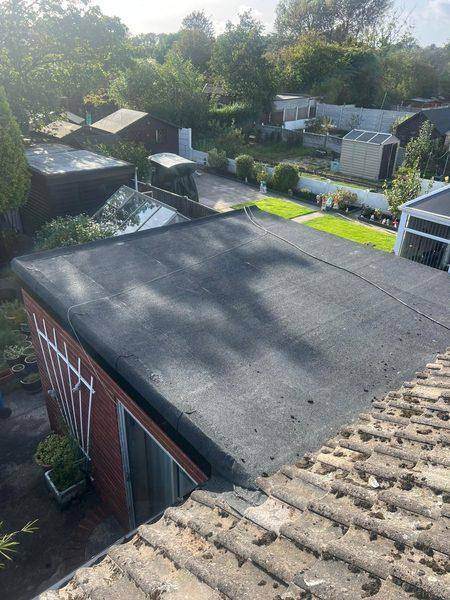
A rotten deck replaced and covered in torch-on felt in Warrington
A leaking flat roof in Warrington taken off to the joists, re-decked in exterior-grade plywood and covered in torch-on felt. See the photographs.
Modern reinforced felt is a long-established way to cover a flat roof. This guide explains the layers, the installation steps and the points that decide how well it lasts.
The felt used on flat roofs now is very different from the thin black sheet many people picture. Modern systems use bitumen reinforced with a polyester or similar base, laid in two or three layers. Each layer is bonded to the one beneath, so the finished roof is a built-up covering rather than a single skin.
Torch-on felt is the best-known type, where the underside is heated to bond it. Other products are stuck with adhesive or mechanically fixed. Which suits your roof depends on the building and the access.
A roof is only as good as its base, so the first stage is the deck. Rotten boards or joists are replaced, and the surface is made clean and level. Insulation may be added, and falls are set so that water runs to the gutter or outlet.
A vapour layer or underlayer is usually laid first, followed by the main layers of felt, each lapped carefully and sealed at the edges. Upstands at walls are formed and the top layer is finished, sometimes with a mineral cap to protect it from sunlight.
A recent job we photographed in Warrington involved a leaking flat roof taken off to the joists, re-decked in exterior-grade plywood and covered in torch-on felt. It is a good example of why the deck gets looked at before any covering goes on.
Quality of installation matters more than any single product. Good laps, sealed edges and well-finished upstands do more for the roof than a thicker layer. Ponding water, poor drainage and foot traffic all shorten life, so these are worth correcting at the start.
Sunlight is hard on bitumen, which is why many felt roofs finish with a mineral cap or a protective coating. Foot traffic is another factor: a roof that is walked on to reach a skylight, an aerial or a gutter wears faster, so a walkway or stepping surface is sometimes worth considering. Keeping the roof clear of leaves and moss also helps.
A split or small blister can sometimes be cut out and patched. If the felt is cracked across large areas, the surface is sagging or the ceiling beneath keeps staining, a full flat roof replacement is usually more sensible than another patch.
If you would like a felt flat roof installed in Cheshire or nearby, we can look at the existing roof and talk it through. A free quotation is available; call to discuss.
Call or message Apex Roofing for a free quotation.
It is reinforced bitumen felt that is bonded to the layer below by heating its underside. It is widely used, but needs a competent installer who takes care with fire safety and details.
Many systems use two or three layers, but it depends on the product and the roof. The manufacturer's specification and the condition of the deck guide the decision.
Occasionally, where the old surface is dry and sound. If the deck is soft or the covering is saturated, stripping back to the boards is the safer route.
Real jobs photographed by Apex Roofing.
A leaking flat roof in Warrington taken off to the joists, re-decked in exterior-grade plywood and covered in torch-on felt. See the photographs.
Apex Roofing covers Cheshire and the surrounding area. Choose your town for local information.
Apex Roofing Cheshire · 5 Weybridge Close, Warrington WA4 5LZ
Tell us about the property and what you have noticed and we will come back to you.
Prefer to talk? Call 07377 461095 · WhatsApp +44 7465 861265 · Email apexroofing14@gmail.com