
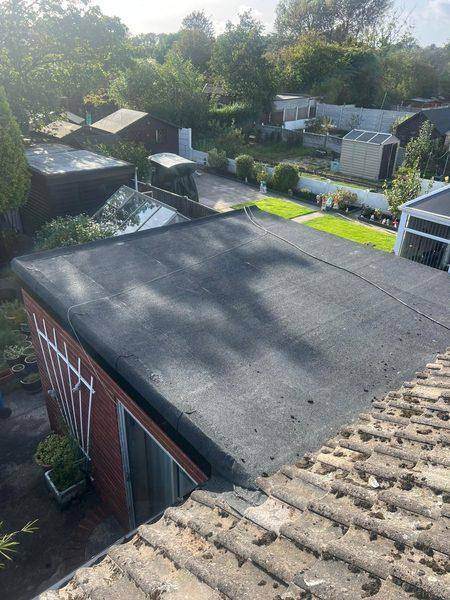
A rotten deck replaced and covered in torch-on felt in Warrington
A leaking flat roof in Warrington taken off to the joists, re-decked in exterior-grade plywood and covered in torch-on felt. See the photographs.
Replacing a flat roof is the best moment to improve its insulation. This guide explains the common build-ups and why moisture control matters as much as thickness.
Many older flat roofs have little or no insulation. When the covering is stripped, the structure is exposed, which makes it far easier to add insulation than at any other time. Doing it later usually means taking the roof apart again.
Insulation affects comfort, heating and condensation. It also changes how the roof behaves, so it needs to be designed rather than simply added.
Flat roofs are generally described in two ways.
Cold roof construction relies on ventilation reaching every part of the void above the insulation. Where a ceiling is boxed in by deep fascias or abuts a wall, airflow can be blocked, and moisture then lingers. That is one reason a warm roof is often favoured when an existing flat roof is being refurbished.
A warm roof is often preferred in refurbishment because it avoids the need for ventilation routes and keeps the structure drier. Which suits your building depends on the ceiling height, the edge details and the existing construction.
Warm air in a house carries moisture. If it reaches cold timber or the underside of the deck, it can condense and cause rot. A vapour control layer below the insulation helps to prevent this. Getting it wrong is a common cause of hidden damage, so the design matters.
Gaps, poor sealing at the edges and penetrations all weaken the layer. These are details a roofer should be willing to explain.
Replacing a large part of a flat roof can bring thermal performance requirements into play. Whether it applies to your project depends on the extent of the work and the building. It is sensible to check with your council or building control before the work begins.
Adding insulation above the deck raises the roof height slightly, which can affect upstands, door thresholds, window sills and the height of edge trims. These should be planned in advance.
Think also about the finish at the edges and around rooflights, as the thicker build-up needs deeper trims and kerbs. Fire performance, load on the structure and the effect on ceiling height may matter in some buildings. These are design questions, not afterthoughts, and they are best answered before materials are ordered.
If you are planning a flat roof replacement in Cheshire or the surrounding area and want insulation considered, we can talk it through on site. A free quotation is available.
Call or message Apex Roofing for a free quotation.
Sometimes, but it is easiest when the covering is being replaced. Adding it without understanding the existing construction risks trapping moisture, so the roof should be assessed first.
In a warm roof the insulation sits above the deck. In a cold roof it sits between the joists with ventilation above. Each has different detailing and suits different situations.
It may need to be, depending on the work involved. Requirements vary, so check with your local council or building control before starting.
Real jobs photographed by Apex Roofing.
A leaking flat roof in Warrington taken off to the joists, re-decked in exterior-grade plywood and covered in torch-on felt. See the photographs.
Apex Roofing covers Cheshire and the surrounding area. Choose your town for local information.
Apex Roofing Cheshire · 5 Weybridge Close, Warrington WA4 5LZ
Tell us about the property and what you have noticed and we will come back to you.
Prefer to talk? Call 07377 461095 · WhatsApp +44 7465 861265 · Email apexroofing14@gmail.com