Re-covering and re-sealing a curved bay roof in Altrincham
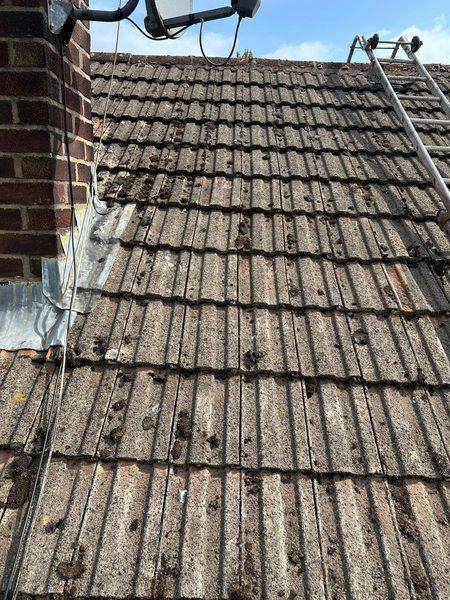
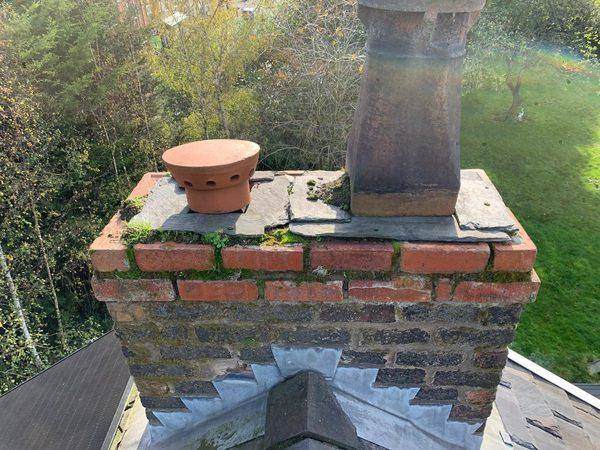
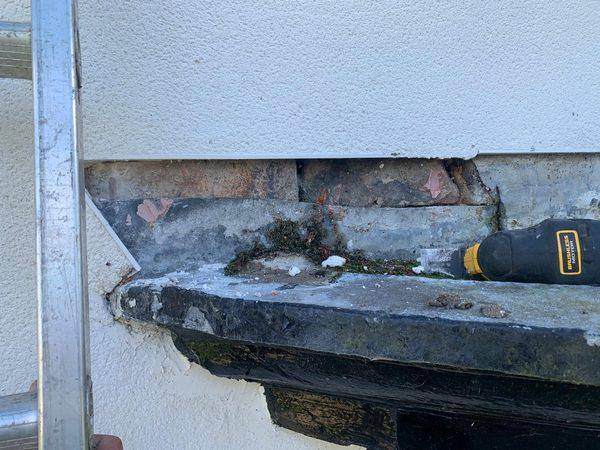
A curved bay window roof in Altrincham stripped back, re-covered and re-sealed at the wall junction after weather damage. Photographs included.
Wherever a roof meets a wall, chimney or dormer, a strip of lead is usually all that stands between the rain and your ceiling. When it fails, the leak can be hard to trace.
Roof coverings shed water well on open slopes, but they cannot seal against a vertical surface by themselves. Flashing is the metal, usually lead, that bridges the gap. One edge is tucked into a groove cut in the wall, called a chase, and the other lies over the roof covering so water runs on to the roof and away.
Flashings are found around chimneys, against party walls and side walls, around dormers and rooflights, and at the lower edge of some bay roofs.
Because the flashing is usually at an awkward junction, signs of failure may show up as damp patches on a chimney breast or wall inside, rather than on the roof.
Sheet lead is graded by code number, which relates to its thickness and weight. Code 4 and Code 5 are widely used for flashings, with heavier codes used for areas that need more strength. The correct code depends on the location, the lengths involved and the exposure of the roof. Your roofer should be able to say what they are using and why.
If the flashing is sound but has come loose, it may be possible to re-fix it by raking out the old mortar from the chase and securing the lead with lead wedges, then repointing. If the lead is cracked, perished or poorly formed, it is better to renew it.
A new flashing is cut and dressed to the profile of the roof covering, tucked into a freshly cleared chase, wedged, and pointed with mortar or sealed with a suitable compound. Joints are lapped, and lengths are kept to a sensible size so the metal can expand without splitting.
A short section of lifted lead can sometimes be put back. Where the flashing is brittle, split along its length or repeatedly repaired, replacement is more reliable. It is also worth checking the surrounding tiles and mortar while the area is open, because they are often part of the same problem.
Prevention is straightforward. Flashings should be looked at whenever other roof work is carried out, and after severe weather. Keeping moss and debris away from the lead and its edges helps too, because water that stands against a joint will find its way through eventually. A short look every few years can catch a lifting edge before it becomes a leak.
If you suspect failed flashing, Apex Roofing offers a free inspection and free quotation. Call to discuss what you have found.
Call or message Apex Roofing for a free quotation.
Look for lifted or cracked lead, gaps at the wall, bitumen tape or sealant patches, and damp stains indoors near a chimney or wall. A roofer can check the junction closely.
Minor lifting may allow a re-fix. Cracked, split or heavily repaired lead is usually better renewed, because patches rarely last.
Lead is the traditional material for flashings because it can be dressed to shape and lasts well. Sealant on its own tends to dry out and crack, so lead is generally the more dependable approach.
Real jobs photographed by Apex Roofing.
A curved bay window roof in Altrincham stripped back, re-covered and re-sealed at the wall junction after weather damage. Photographs included.
Ridge and hip repointing, chimney leadwork made good and both pots re-bedded on a Blackpool house. Photographs of each stage of the work.
Mossy mortar raked out of a stone-slated roof in Warrington. The chimney cow was re-bedded and the flaunching renewed, then the whole ridge line was re-pointed.
Apex Roofing covers Cheshire and the surrounding area. Choose your town for local information.
Apex Roofing Cheshire · 5 Weybridge Close, Warrington WA4 5LZ
Tell us about the property and what you have noticed and we will come back to you.
Prefer to talk? Call 07377 461095 · WhatsApp +44 7465 861265 · Email apexroofing14@gmail.com