Re-covering and re-sealing a curved bay roof in Altrincham
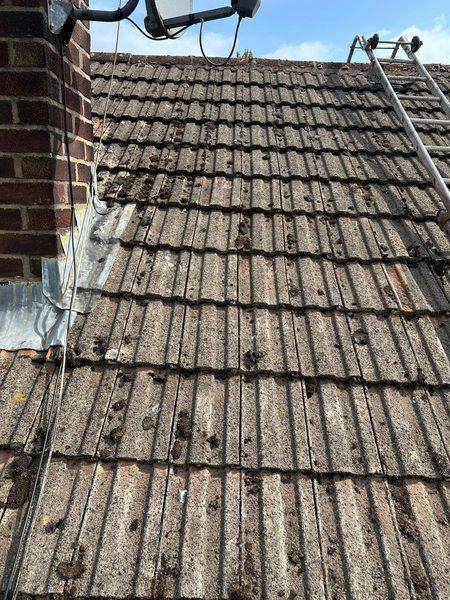
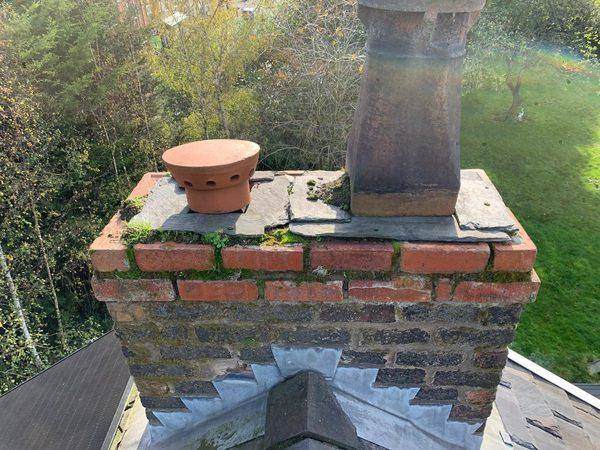
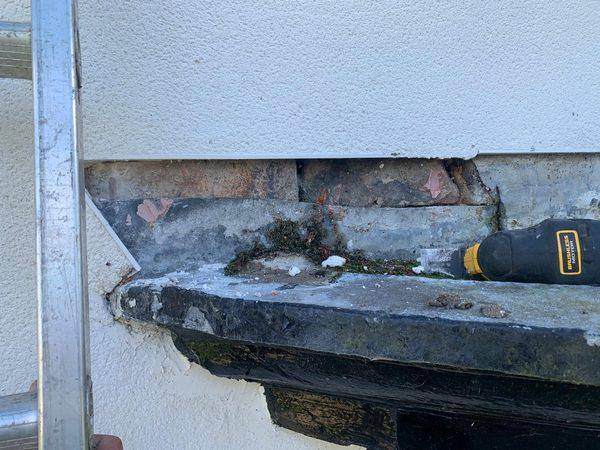
A curved bay window roof in Altrincham stripped back, re-covered and re-sealed at the wall junction after weather damage. Photographs included.
A stain on the ceiling rarely sits under the hole that caused it. Good leaking roof repairs begin with tracing the water back to its true entry point, then fixing that and nothing more.
Water that gets through a roof covering seldom drops straight down. It runs along the top of the underlay, down a rafter or across a batten, and can travel a metre or more before it soaks into the ceiling. The damp patch you see indoors is only the place where the water finally gave up.
This is why guessing at a leak and smearing sealant on the nearest tile so often fails. The leak comes back at the next heavy shower, and by then the timbers have had another soaking.
Age matters too. Old bitumen felt under a tiled roof can tear or perish, and water then finds its way in even when the tiles themselves look fine from the ground.
A proper inspection works from the inside out and the outside in. Indoors, the loft is checked for wet timbers, stained insulation and daylight where there should be none. On the roof, the covering, flashings, valleys and ridge are checked slope by slope, working up from the point where the water is showing.
Where the cause is not obvious, a controlled water test can help. Water is run onto one section of roof at a time while someone watches for it indoors, so the entry point can be isolated rather than assumed.
Once the entry point is found, the repair is matched to it. A slipped slate may be replaced with a suitable fixing. A failed flashing may need stripping back and renewing in lead. A choked valley is cleared and, where the lining has failed, relined. A split flat roof section may be cut out and patched, or its joint redone.
Wet insulation and damaged battens are then dealt with if they are part of the problem. Leaving soaked timber in place only stores up trouble, including rot, so it is better to look at it than to cover it over.
The right fix depends on the roof covering, its age, how accessible the area is and how much surrounding material is sound. A single defect on an otherwise healthy roof suits a targeted repair. A roof where the underlay has perished and several areas are letting water in is a different conversation.
Repeated leaks in different places, widespread cracking, sagging sections or large areas of rotten battens can mean patching is just buying time. In that case it is worth asking whether stripping and re-covering a section, or the whole slope, makes more sense than a string of small repairs. An honest roofer will tell you which it is.
If you have a leak and want it traced properly, Apex Roofing offers a free survey and a free quotation. Call to talk it through and we will advise on the next step.
Call or message Apex Roofing for a free quotation.
Often, yes. When the leak comes from a single defect such as a slipped tile or a failed flashing, a targeted repair is usually enough. Widespread wear is different, and an inspection will show which applies.
Small gaps may only let water through when rain is driven by wind or runs in volume. Valleys, flashings and ridge joints are common culprits because they only fail under load.
Usually not on its own. Sealant can hide a problem for a while, but it does not replace a worn flashing or a missing tile, and it can make later repairs harder.
Real jobs photographed by Apex Roofing.
A curved bay window roof in Altrincham stripped back, re-covered and re-sealed at the wall junction after weather damage. Photographs included.
Ridge and hip repointing, chimney leadwork made good and both pots re-bedded on a Blackpool house. Photographs of each stage of the work.
Mossy mortar raked out of a stone-slated roof in Warrington. The chimney cow was re-bedded and the flaunching renewed, then the whole ridge line was re-pointed.
Apex Roofing covers Cheshire and the surrounding area. Choose your town for local information.
Apex Roofing Cheshire · 5 Weybridge Close, Warrington WA4 5LZ
Tell us about the property and what you have noticed and we will come back to you.
Prefer to talk? Call 07377 461095 · WhatsApp +44 7465 861265 · Email apexroofing14@gmail.com