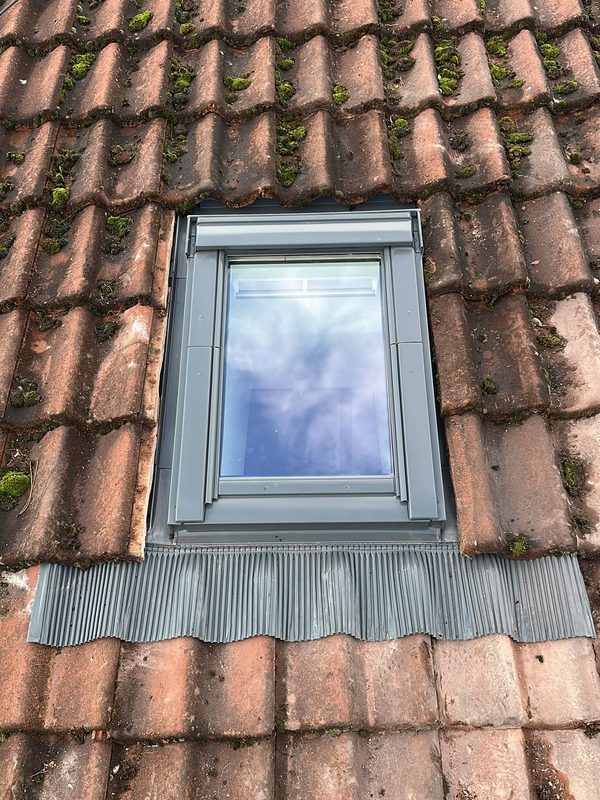
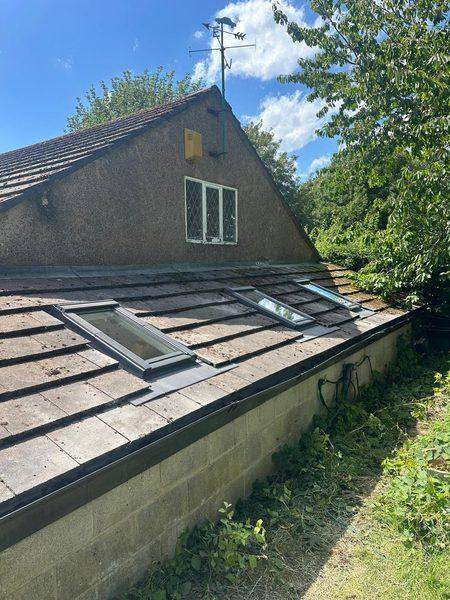
Two roof windows cut into a tiled back roof in Macclesfield
Two roof windows cut into the low tiled roof of a single storey range in Macclesfield, trimmed, felted, flashed and the concrete tiles relaid around them.
A drip below a roof window does not always mean the window is at fault. The job is to trace the water back to where it actually gets in, and then repair that.
Before anything else, work out what kind of water it is. Condensation forms on the cold glass and frame, especially in bathrooms, kitchens and bedrooms in cold weather. It tends to appear on the inside surfaces and on cold mornings. A leak tends to appear after rain, usually at the corners or at the bottom of the frame, and may stain the lining or ceiling.
We start from outside, looking at the flashing, the surrounding covering and the gutter-like channels around the frame. Debris tucked against the upper edge is a common culprit, because it makes water back up instead of running past.
Next, inside the room and loft if accessible. Staining on the timbers around the opening shows where water has been travelling. Wet insulation or darkened rafters can point to a source above.
Where the cause is not obvious, the roof can be tested by running water over sections in turn, starting low and working upwards, so that the entry point is identified rather than guessed.
The repair follows the cause. It might be clearing debris, replacing a cracked tile, refitting a flashing, renewing an underlay collar or replacing worn seals. If the window is old and the frame is damaged, replacing it may make more sense than repeated repairs.
If water has been getting in for some time, check the timbers, insulation and plaster around the window. Rotten battens or rafters should be replaced rather than covered. Wet insulation loses its effectiveness and should be dried or renewed.
A steady drip into a room is something to deal with promptly. Put a bucket down, protect furniture and call to discuss current availability for a repair. For storm-damage repairs we ask that you call to discuss what is possible.
Keep a note of when the leak shows. If it only appears in driving rain from one direction, that points to a particular edge. If it shows after every shower, the cause is probably more general. If it appears on cold mornings with no rain, it is more likely to be condensation. That detail helps a roofer narrow down the search quickly.
Some questions are worth putting to any roofer before you agree to the work.
If you are thinking about roof windows, call Apex Roofing to arrange a free quotation. We will look at the roof, talk through what is possible and tell you honestly what we would recommend.
Call or message Apex Roofing for a free quotation.
Possible causes include flashing, seals, damaged tiles or blocked drainage. Finding the real one needs a close inspection.
Often, yes. Many leaks are in the flashing or surrounding roof, not the window itself.
It is better not to. Sealant tends to hide the problem and can make a proper repair harder later.
Real jobs photographed by Apex Roofing.
Two roof windows cut into the low tiled roof of a single storey range in Macclesfield, trimmed, felted, flashed and the concrete tiles relaid around them.
A roof window cut into an old tiled roof in Warrington: tiles lifted, opening trimmed, felt collar dressed round the frame, flashing fitted and tiles relaid.
Apex Roofing covers Cheshire and the surrounding area. Choose your town for local information.
Apex Roofing Cheshire · 5 Weybridge Close, Warrington WA4 5LZ
Tell us about the property and what you have noticed and we will come back to you.
Prefer to talk? Call 07377 461095 · WhatsApp +44 7465 861265 · Email apexroofing14@gmail.com