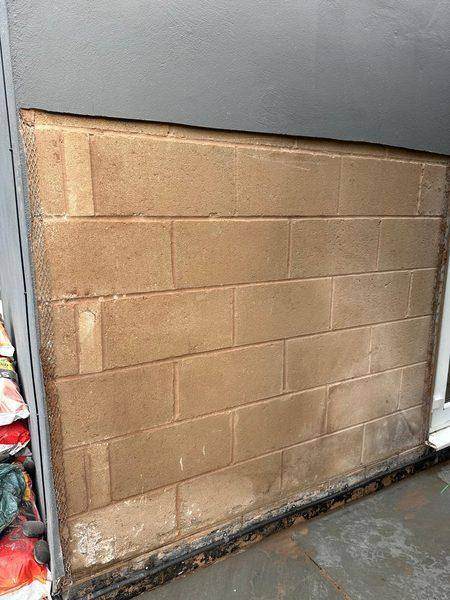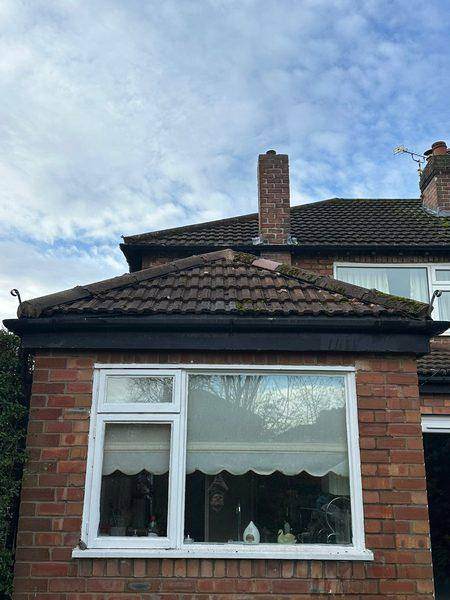
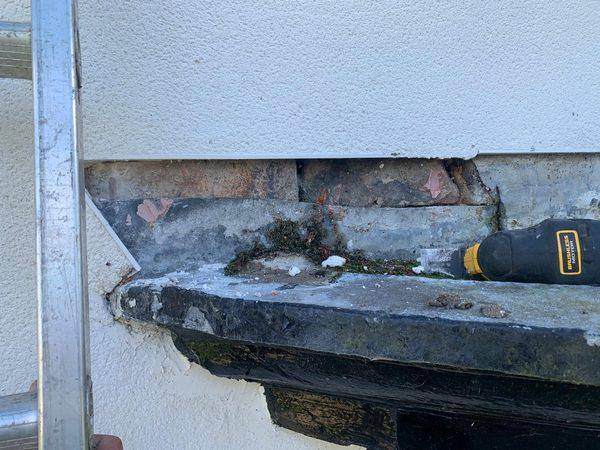
Re-covering and re-sealing a curved bay roof in Altrincham
A curved bay window roof in Altrincham stripped back, re-covered and re-sealed at the wall junction after weather damage. Photographs included.
Where a chimney meets the roof, lead flashing does the sealing that tiles cannot. Here is how it fails, how to spot it and what a sound repair involves.
A chimney stack pokes up through the roof, so water has to be kept out along all four sides. Lead flashing does that job. It is dressed over the tiles or slates on one side and tucked into the brickwork on the other, forming a seal that can flex a little as the building moves.
Most chimney leaks do not start in the stack itself. They start where the flashing has lifted, cracked or lost its grip on the masonry. That is why chimney lead flashing repairs are one of the most common leadwork jobs.
From the ground you may see lead hanging away from the brickwork, gaps along the joint, or a dark stain running down the stack. Inside, look for damp marks on the chimney breast, in the bedroom or loft around the stack, or peeling paint that returns after redecorating.
Pointing matters as much as the lead. Lead is normally held into a raked-out mortar joint, and when that mortar crumbles the lead loosens. Sometimes the only repair needed is to repoint and re-wedge the lead; sometimes the lead itself has split.
A thick bead of sealant over old lead is a temporary cover-up rather than a repair. It tends to crack again and can hide what is going on underneath.
The size and position of the stack, the roof pitch, the condition of the brickwork and whether the roof is tiled or slated all feed into the decision. Lead is available in different codes of thickness, and the right one depends on the position and exposure of the flashing.
If the lead is thin, widely cracked or lifted all round the stack, patching is rarely worth it and renewing the full set of flashings makes more sense. The same applies if the stack is leaning, the brickwork is badly eroded or the crown on top is breaking up. Those need dealing with first, and the flashing then goes on to sound masonry.
Ask which parts of the flashing are being renewed, what lead code is proposed, whether the joints are being repointed and how the work will be tested afterwards. A good answer is specific.
If you have damp near a chimney and want it looked at, we offer a free survey and a free quotation. Call us to talk through what you are seeing.
Call or message Apex Roofing for a free quotation.
Small areas of lifted lead or failed pointing can often be repaired. If the lead is cracked in several places or has been patched repeatedly, renewing the whole flashing is usually the more sensible route. It depends on what the inspection shows.
Not always. Failed pointing, a cracked crown, a missing cowl or condensation can cause similar marks. The flashing is a common culprit, so it is one of the first things to check.
Sealant can slow a leak briefly, but it hardens and cracks as the roof moves. Lead properly dressed and fixed into the masonry lasts far better and is the usual approach.
Real jobs photographed by Apex Roofing.
A curved bay window roof in Altrincham stripped back, re-covered and re-sealed at the wall junction after weather damage. Photographs included.
Damp near a chimney breast in Warrington traced to the stack. Joints repointed, new Code 4 lead fitted, the crown repaired and a water test run afterwards.
A leaking kitchen roof in Sale taken back to the rafters, re-covered on new breathable underlay and treated battens, with the lead at the wall renewed.
Apex Roofing covers Cheshire and the surrounding area. Choose your town for local information.
Apex Roofing Cheshire · 5 Weybridge Close, Warrington WA4 5LZ
Tell us about the property and what you have noticed and we will come back to you.
Prefer to talk? Call 07377 461095 · WhatsApp +44 7465 861265 · Email apexroofing14@gmail.com