Re-covering and re-sealing a curved bay roof in Altrincham
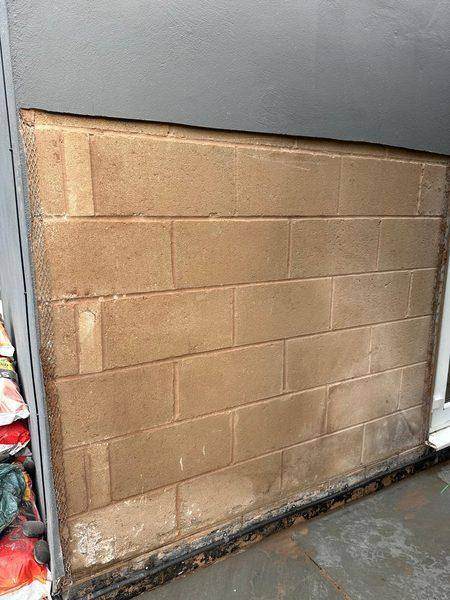
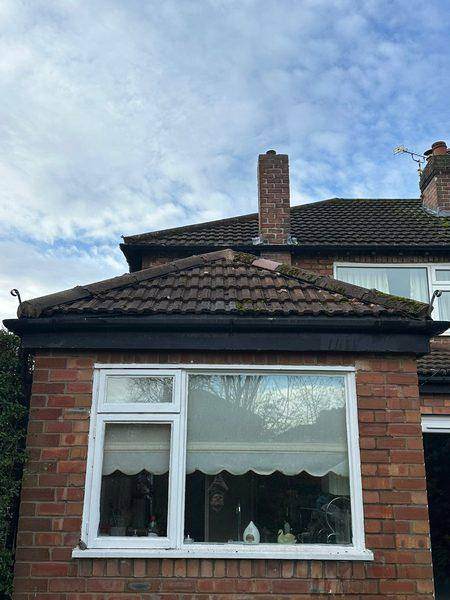
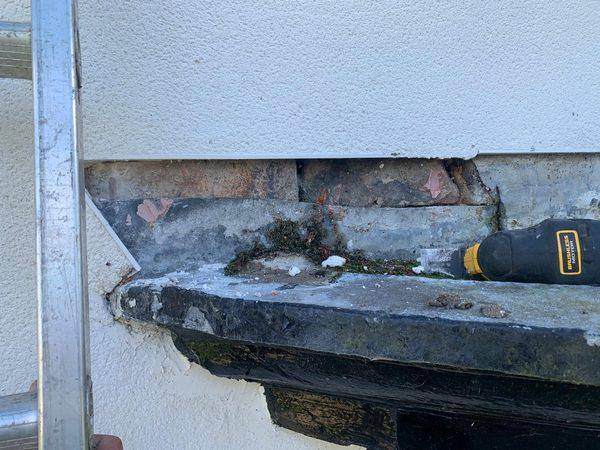
A curved bay window roof in Altrincham stripped back, re-covered and re-sealed at the wall junction after weather damage. Photographs included.
Lead capping sits on top of walls and parapets, taking the full force of sun, wind and rain. Here is how it fails and how it can be repaired or renewed.
The top of a wall is its most exposed surface. A parapet, a gable wall or a chimney crown that is left open will soak up rainwater and push damp down through the masonry. A cap of lead, or a coping of stone, brick or concrete, is there to shed water outward.
Lead capping is dressed over the top and down both faces of the wall. It is a more flexible solution than rigid coping stones, and it is often used on parapets and around features where the surface is awkward.
In some places, lead has also been removed by thieves. If you can see that lead has gone altogether, it is worth having the area covered quickly and reporting it as appropriate.
Staining down the face of a parapet wall, damp on the ceiling next to a parapet, and moss or plant growth along the top are all clues. Where capping is visible, look for gaps at joints, raised edges and cracks at corners. Parapets next to flat roofs often leak inside before anything shows outside.
Wall width, exposure, height and the adjoining roof structure all play a part. A narrow garden wall and a tall parapet are different jobs. On some buildings, the use of lead may be affected by whether the property is listed or in a conservation area, so it is sensible to check with the council or a surveyor where that applies.
Where the masonry under the cap is saturated, spalling or loose, the wall needs rebuilding or repointing before new capping is fitted. If lead has been widely patched, replacing the lot is often better than adding more repairs.
Ask what thickness of lead is proposed, how long each sheet is, how the edges are held down and what is being done about the masonry. If you have a parapet or wall top that needs attention, we can arrange a free inspection and give a free quotation.
Call or message Apex Roofing for a free quotation.
Coping is usually a solid material such as stone or concrete that sits on the wall top. Capping tends to refer to a sheet covering such as lead. Both do the same job of keeping rain out of the wall.
Lead expands and contracts with temperature. Long sheets without proper movement joints can stretch and split. Poor fixing and foot traffic add to the wear.
Often yes, once the masonry is sound. The right detail depends on the wall, so it needs to be looked at in person.
Real jobs photographed by Apex Roofing.
A curved bay window roof in Altrincham stripped back, re-covered and re-sealed at the wall junction after weather damage. Photographs included.
Damp near a chimney breast in Warrington traced to the stack. Joints repointed, new Code 4 lead fitted, the crown repaired and a water test run afterwards.
A leaking kitchen roof in Sale taken back to the rafters, re-covered on new breathable underlay and treated battens, with the lead at the wall renewed.
Apex Roofing covers Cheshire and the surrounding area. Choose your town for local information.
Apex Roofing Cheshire · 5 Weybridge Close, Warrington WA4 5LZ
Tell us about the property and what you have noticed and we will come back to you.
Prefer to talk? Call 07377 461095 · WhatsApp +44 7465 861265 · Email apexroofing14@gmail.com